Main menu

  • Foundation Website
  • Journal Home
  • Issues
    • Current Issue
    • All Issues
    • Future Issues
  • For Authors and Editors
    • Overview of RSF & How to Propose an Issue
    • RSF Style and Submission Guidelines
    • Article Submission Checklist
    • Permission Request Form for Authors to Request Permission from other Publishers
    • Terms of Contributor Agreement Form and Transfer of Copyright
    • RSF Contributor Agreement Form
    • Issue Editors' Agreement Form
    • RSF Policy on the Use of AI
  • About the Journal
    • Mission Statement
    • Editorial Board
    • Comments and Replies Policy
    • Journal Code of Ethics
    • Current Calls for Articles
    • Closed Calls for Articles
    • Abstracting and Indexing
    • Privacy Policy
    • Copyright and ISSN Information
    • Terms of Use
    • Contact Us
  • Publications
    • rsf

User menu

  • Log in

Search

  • Advanced search
RSF: The Russell Sage Foundation Journal of the Social Sciences
  • Publications
    • rsf
  • Log in
RSF: The Russell Sage Foundation Journal of the Social Sciences

Advanced Search

  • Foundation Website
  • Journal Home
  • Issues
    • Current Issue
    • All Issues
    • Future Issues
  • For Authors and Editors
    • Overview of RSF & How to Propose an Issue
    • RSF Style and Submission Guidelines
    • Article Submission Checklist
    • Permission Request Form for Authors to Request Permission from other Publishers
    • Terms of Contributor Agreement Form and Transfer of Copyright
    • RSF Contributor Agreement Form
    • Issue Editors' Agreement Form
    • RSF Policy on the Use of AI
  • About the Journal
    • Mission Statement
    • Editorial Board
    • Comments and Replies Policy
    • Journal Code of Ethics
    • Current Calls for Articles
    • Closed Calls for Articles
    • Abstracting and Indexing
    • Privacy Policy
    • Copyright and ISSN Information
    • Terms of Use
    • Contact Us
  • Follow rsf on Twitter
  • Visit rsf on Facebook
  • Follow rsf on Google Plus
Research ArticleII. Status Is Relational, Cultural, and Multilevel
Open Access

Status Lenses: Mapping Hierarchy and Consensus in Status Beliefs

Lauren Valentino
RSF: The Russell Sage Foundation Journal of the Social Sciences November 2022, 8 (7) 89-110; DOI: https://doi.org/10.7758/RSF.2022.8.7.05
Lauren Valentino
aAssistant professor in the Department of Sociology at The Ohio State University, United States
  • Find this author on Google Scholar
  • Find this author on PubMed
  • Search for this author on this site
  • ORCID record for Lauren Valentino
  • Article
  • Figures & Data
  • References
  • Info & Metrics
  • PDF
Loading

Article Figures & Data

Figures

  • Tables
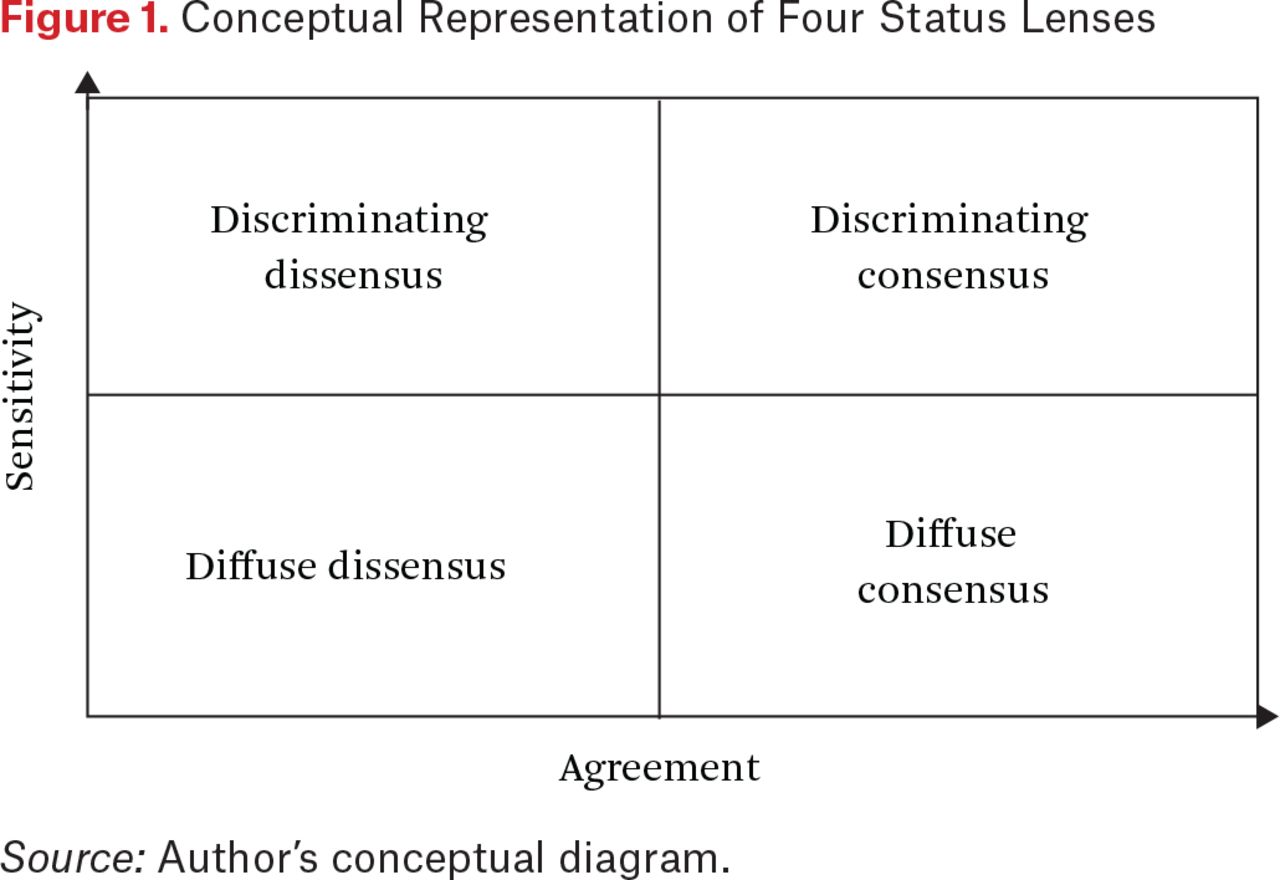
  • Conceptual Representation of Four Status Lenses Source: Author’s conceptual diagram.
    • Download figure
    • Open in new tab
    • Download powerpoint
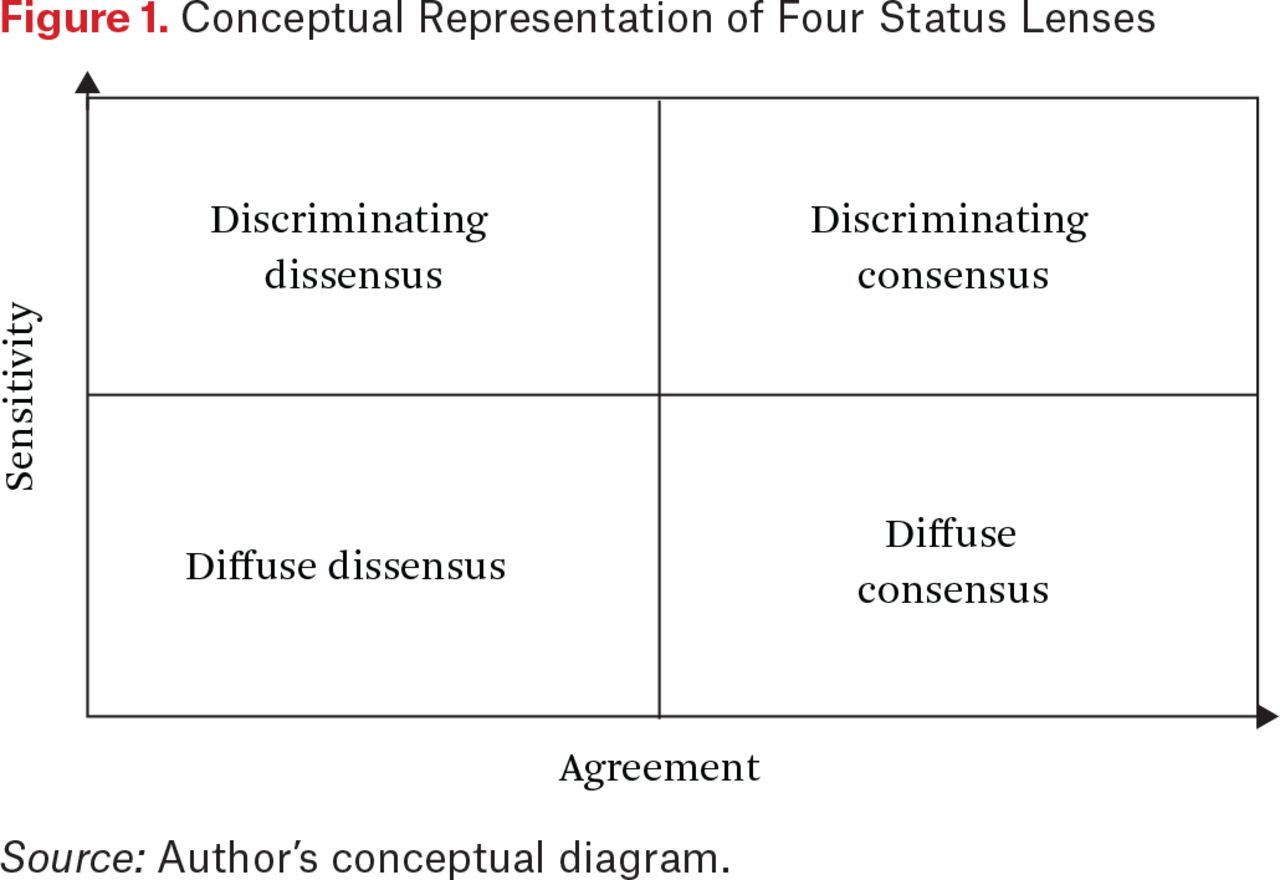
    Figure 1.

    Conceptual Representation of Four Status Lenses

    Source: Author’s conceptual diagram.

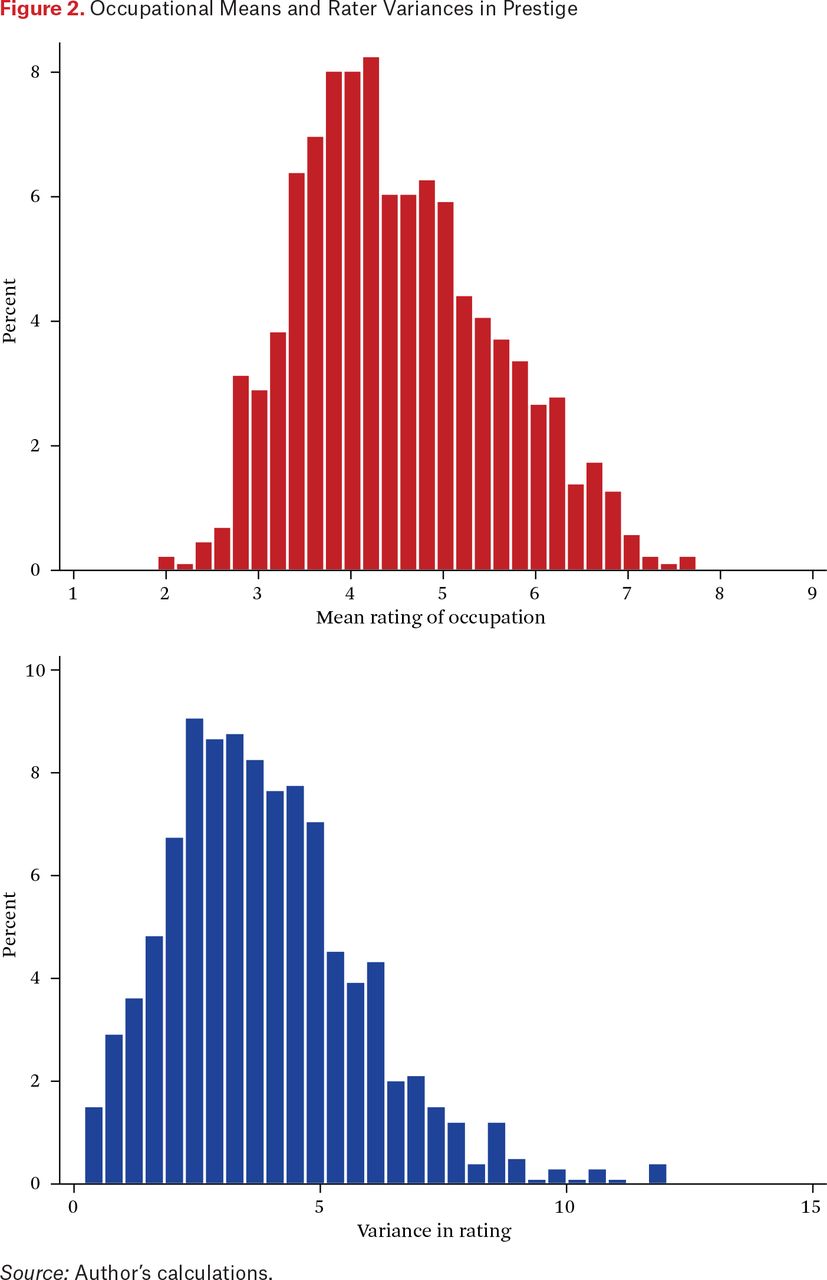
  • Occupational Means and Rater Variances in Prestige Source: Author’s calculations.
    • Download figure
    • Open in new tab
    • Download powerpoint
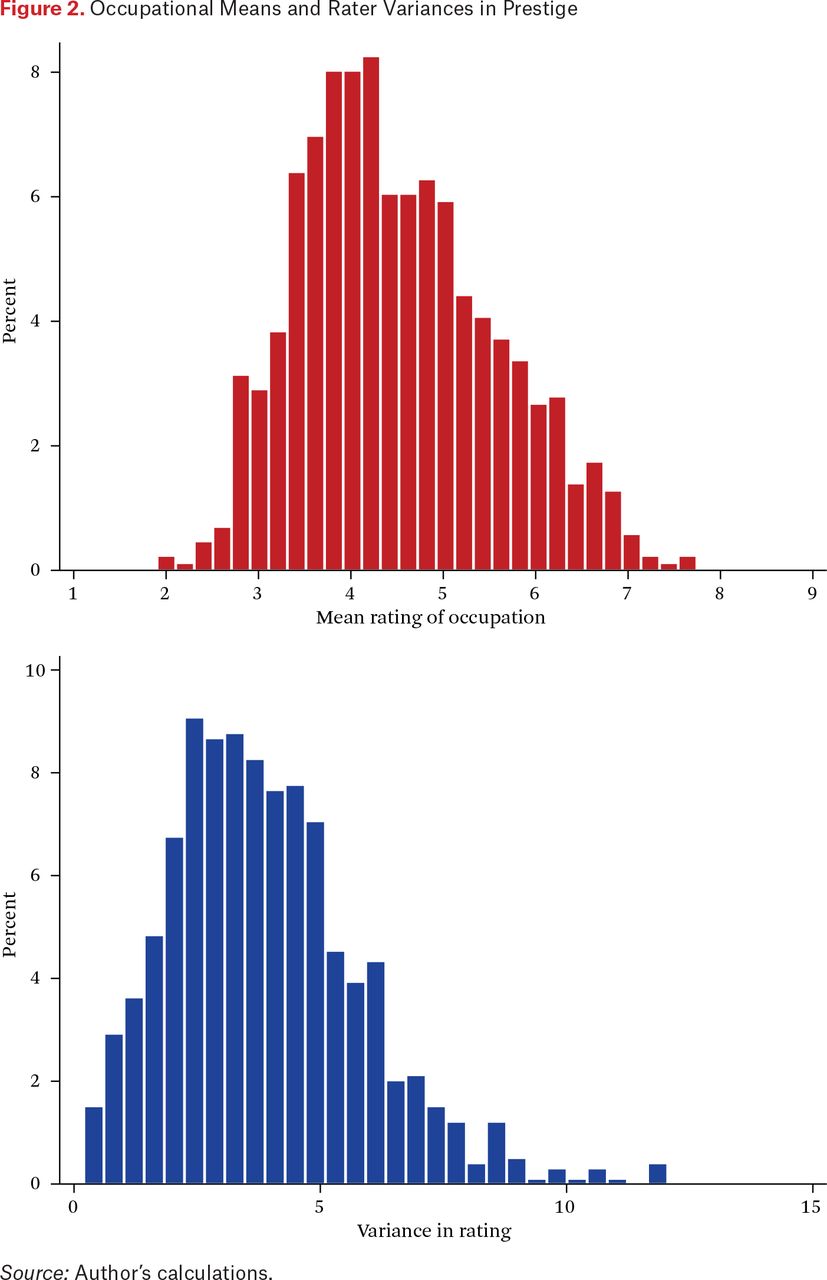
    Figure 2.

    Occupational Means and Rater Variances in Prestige

    Source: Author’s calculations.

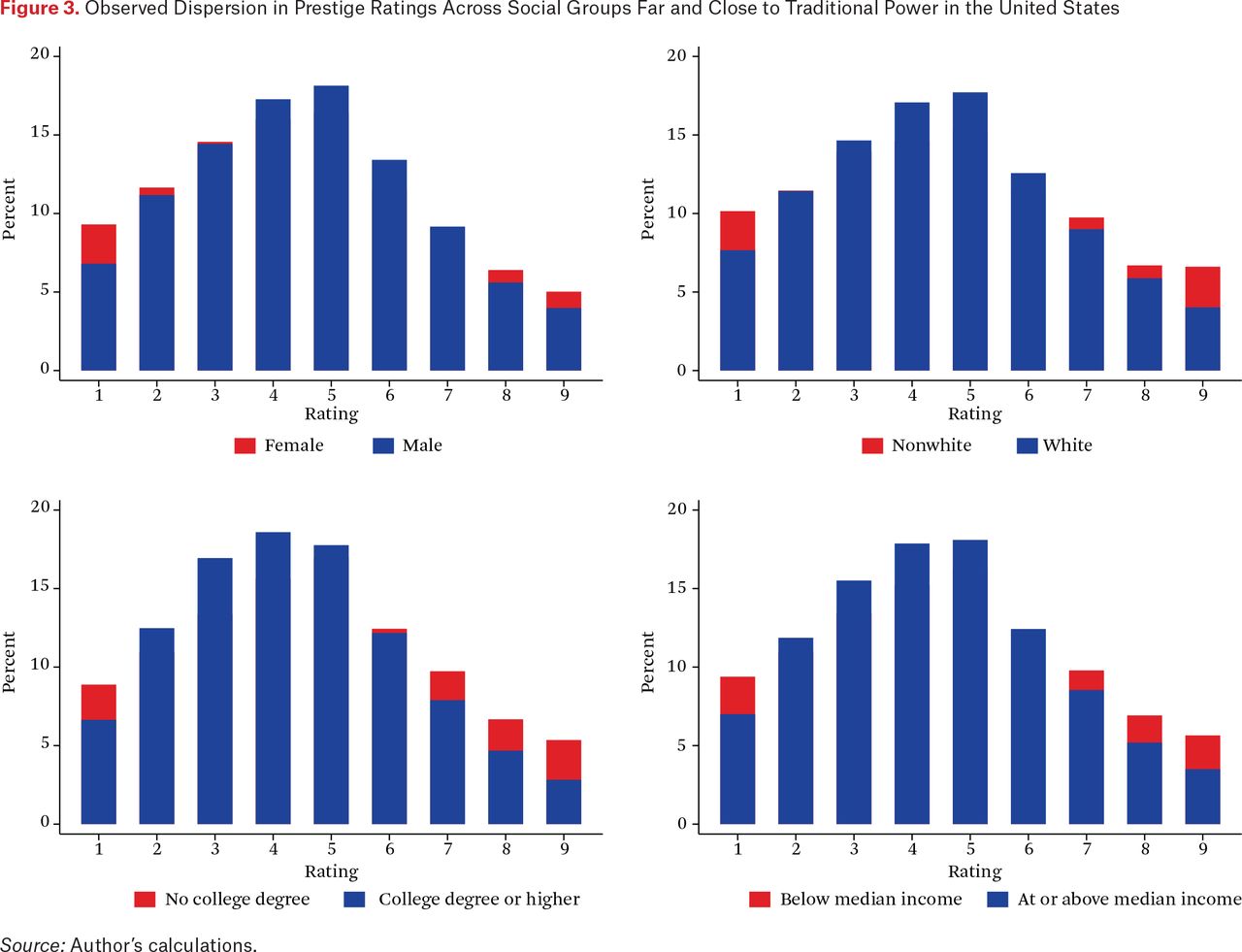
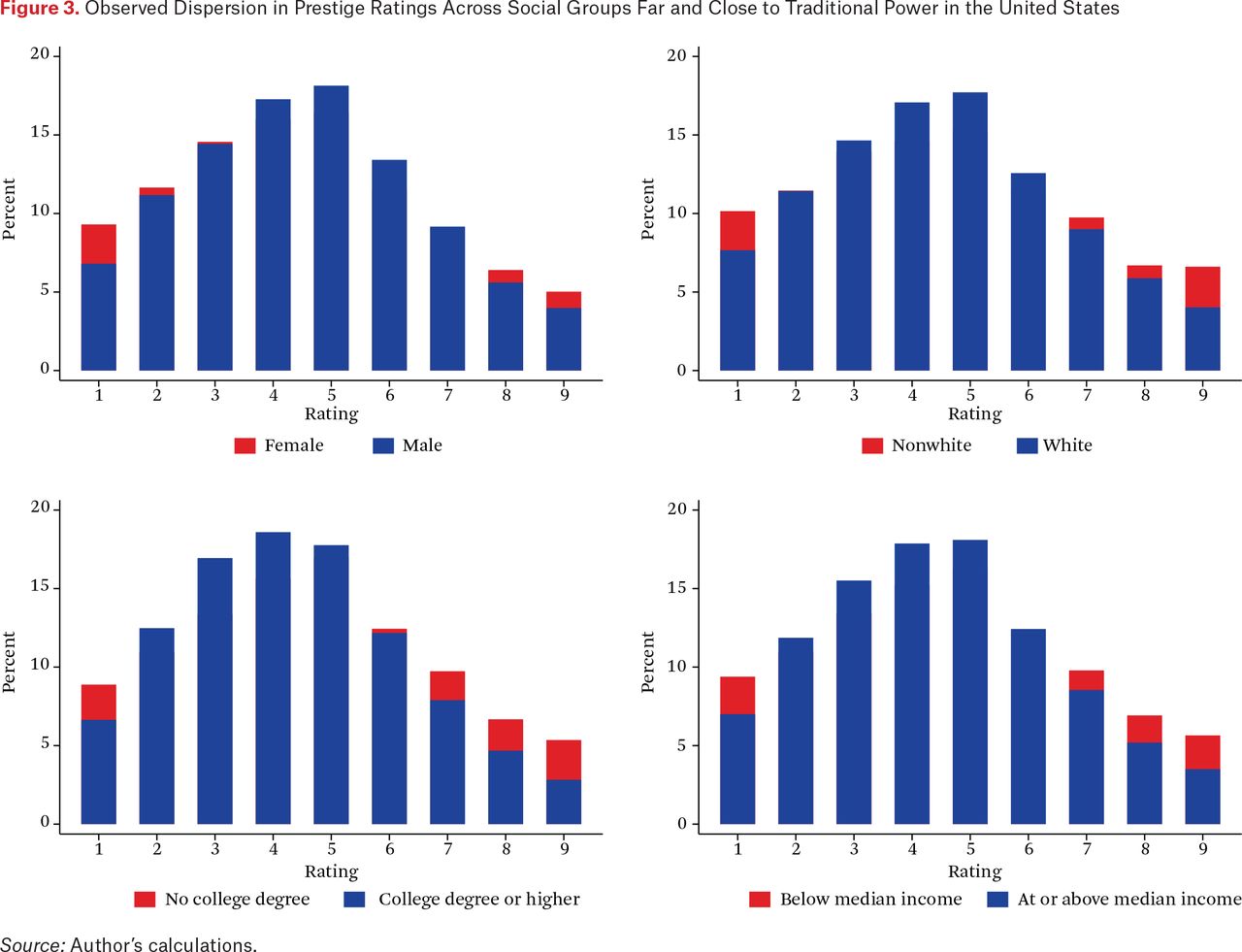
  • Observed Dispersion in Prestige Ratings Across Social Groups Far and Close to Traditional Power in the United States Source: Author’s calculations.
    • Download figure
    • Open in new tab
    • Download powerpoint
    Figure 3.

    Observed Dispersion in Prestige Ratings Across Social Groups Far and Close to Traditional Power in the United States

    Source: Author’s calculations.

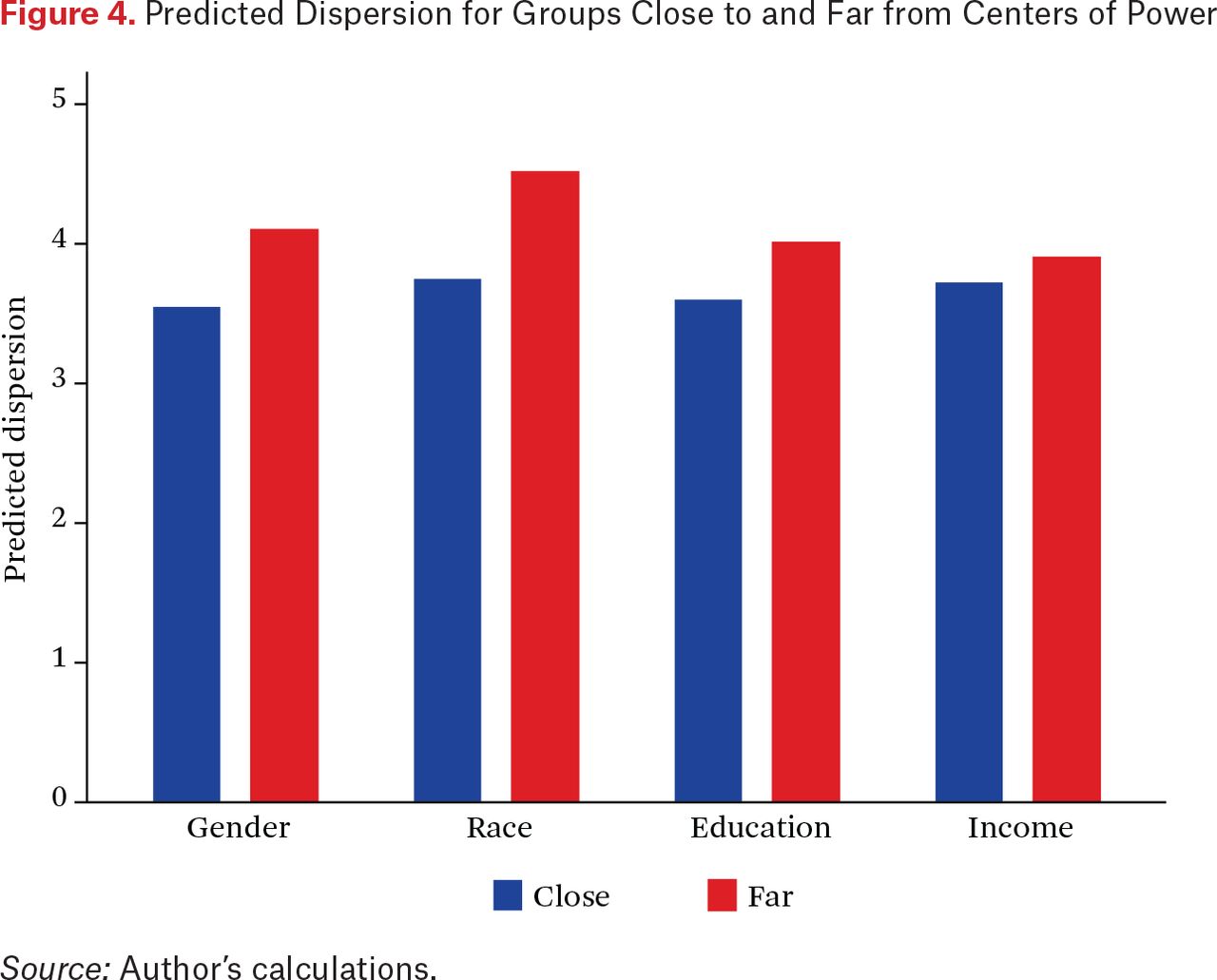
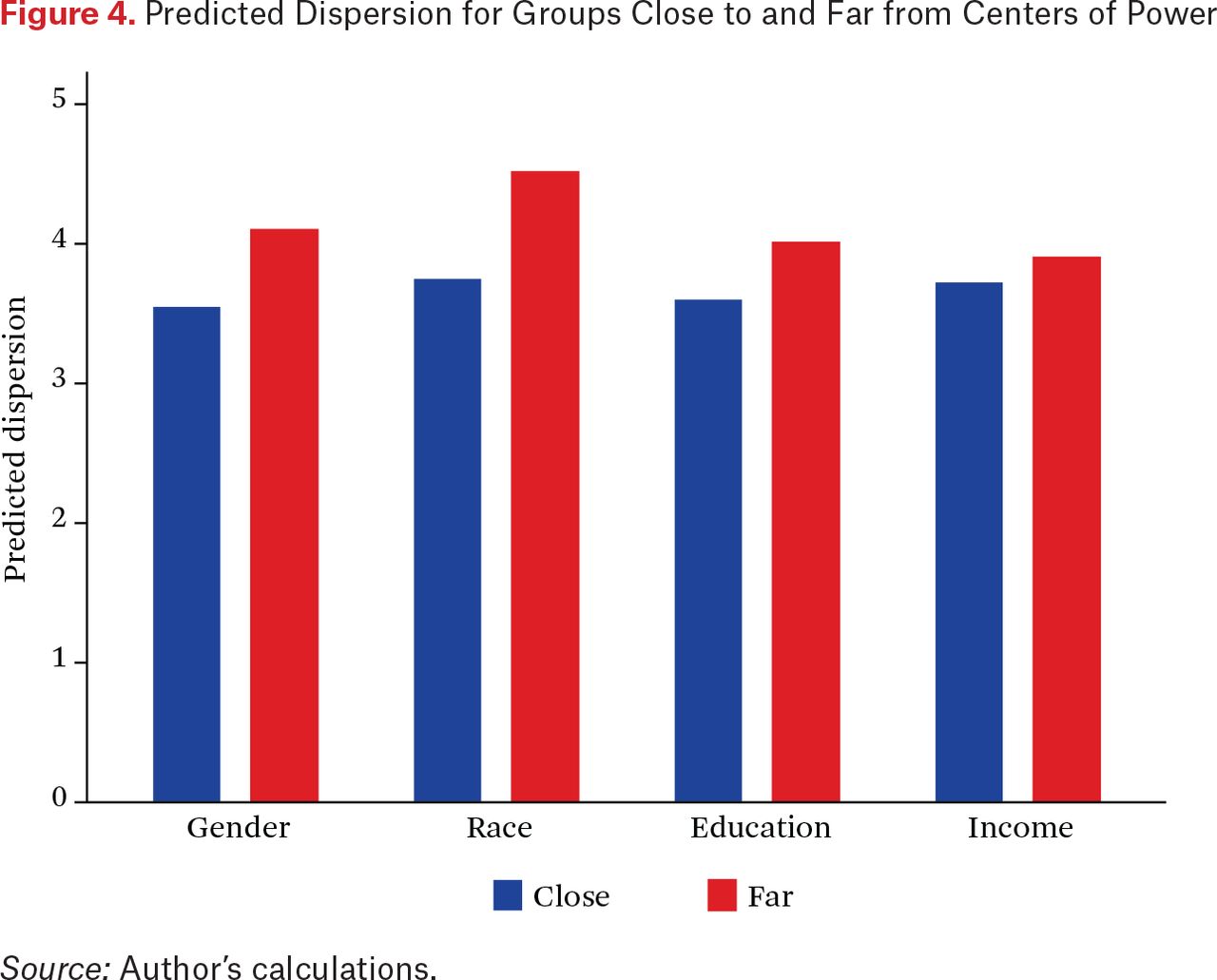
  • Predicted Dispersion for Groups Close to and Far from Centers of Power Source: Author’s calculations.
    • Download figure
    • Open in new tab
    • Download powerpoint
    Figure 4.

    Predicted Dispersion for Groups Close to and Far from Centers of Power

    Source: Author’s calculations.

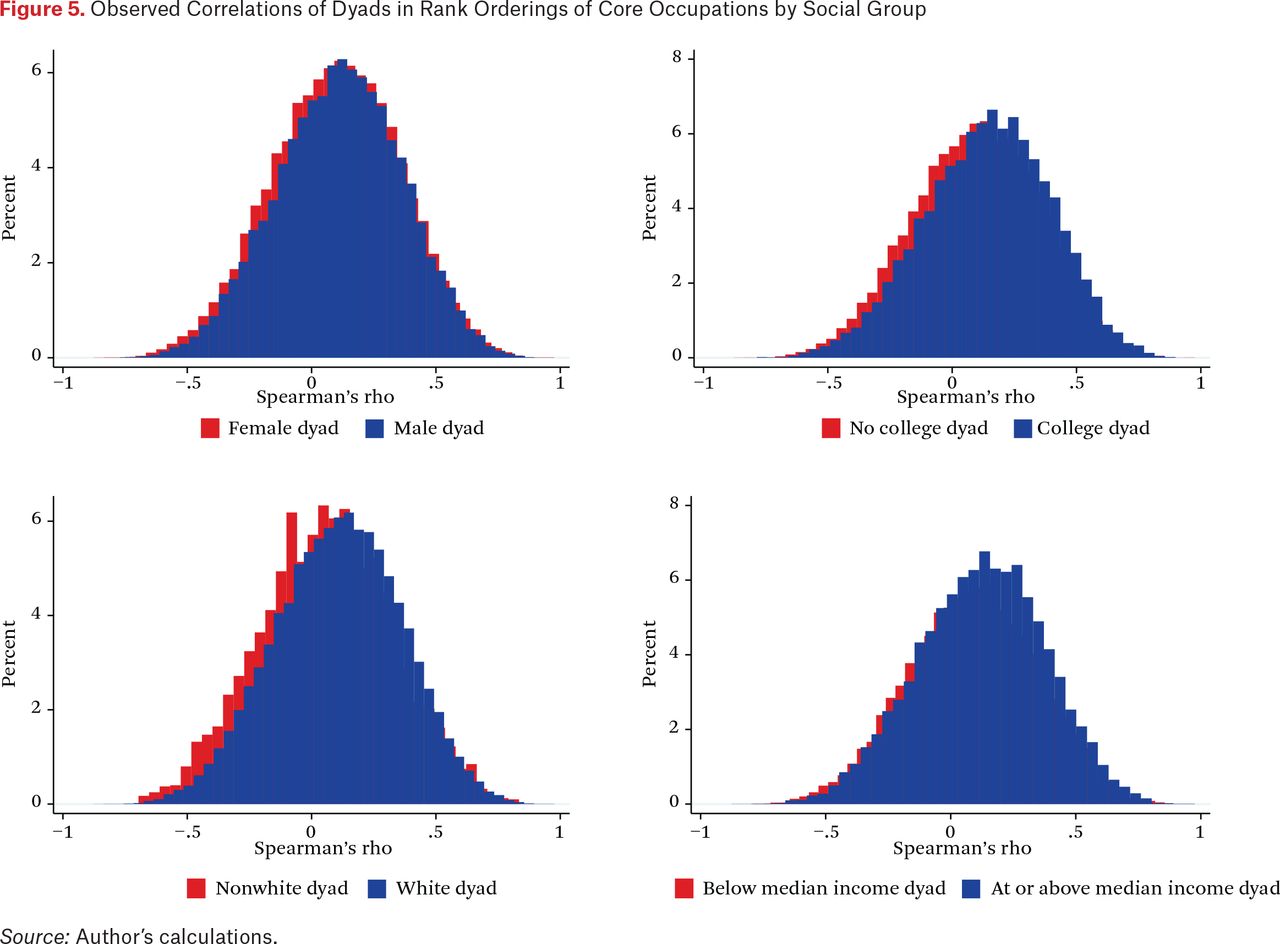
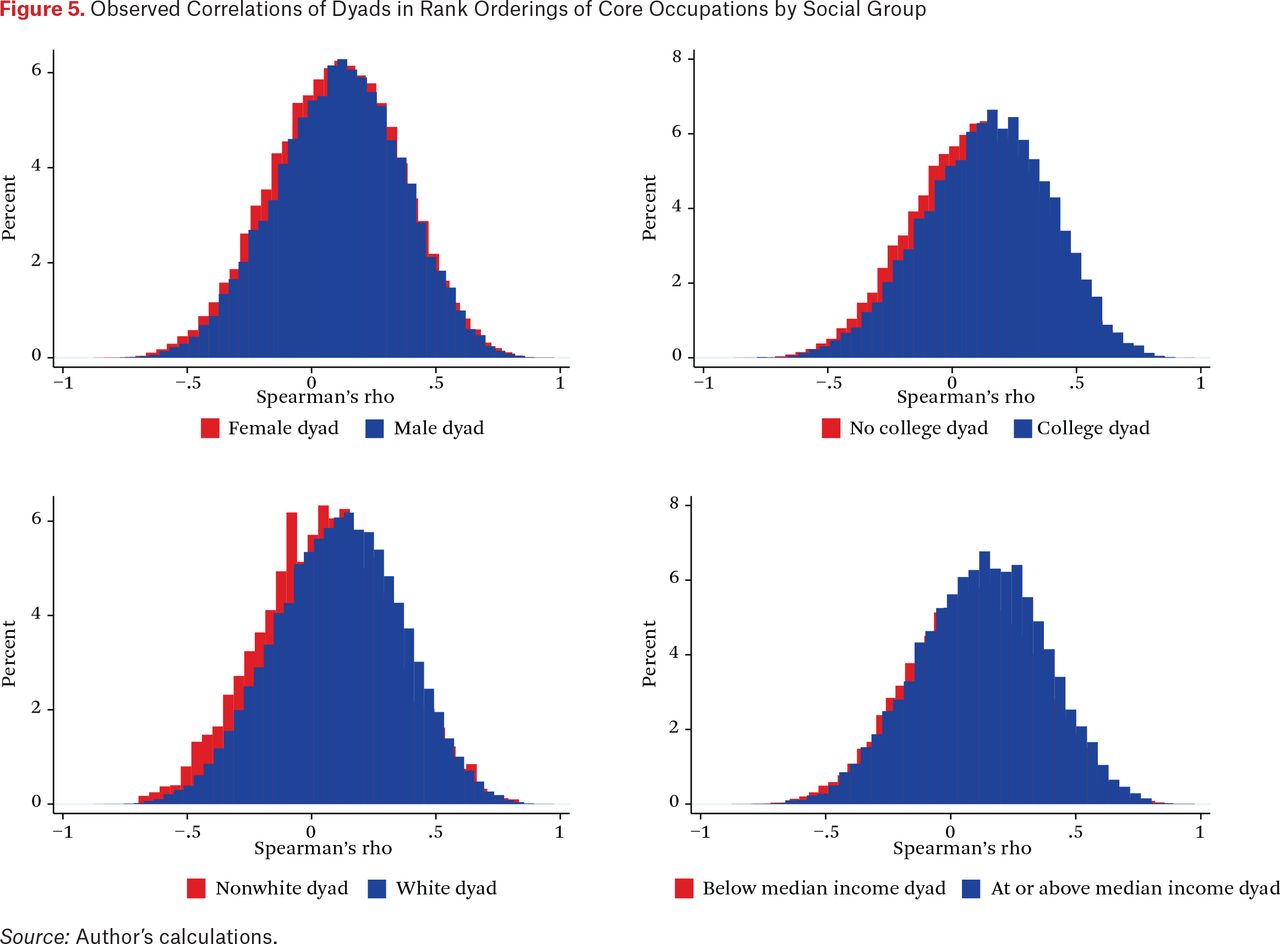
  • Observed Correlations of Dyads in Rank Orderings of Core Occupations by Social Group Source: Author’s calculations.
    • Download figure
    • Open in new tab
    • Download powerpoint
    Figure 5.

    Observed Correlations of Dyads in Rank Orderings of Core Occupations by Social Group

    Source: Author’s calculations.

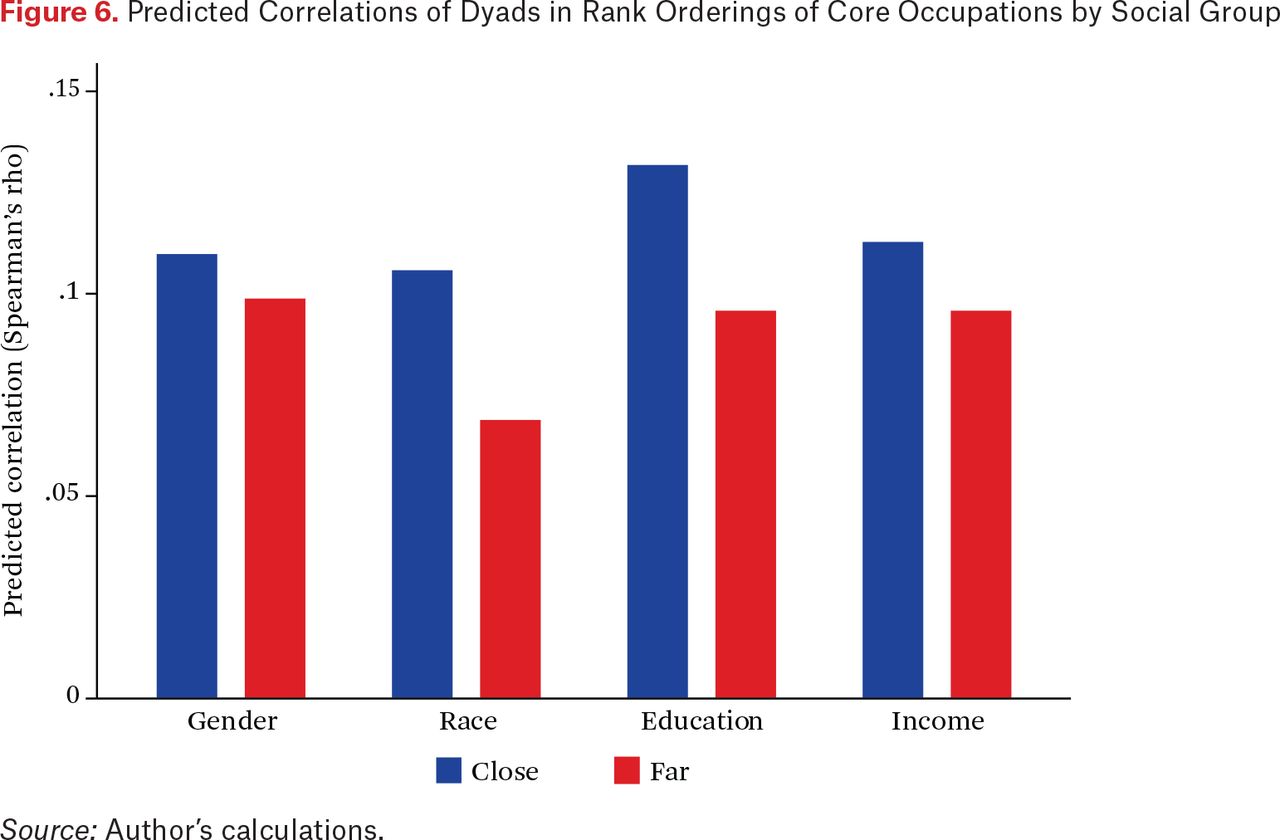
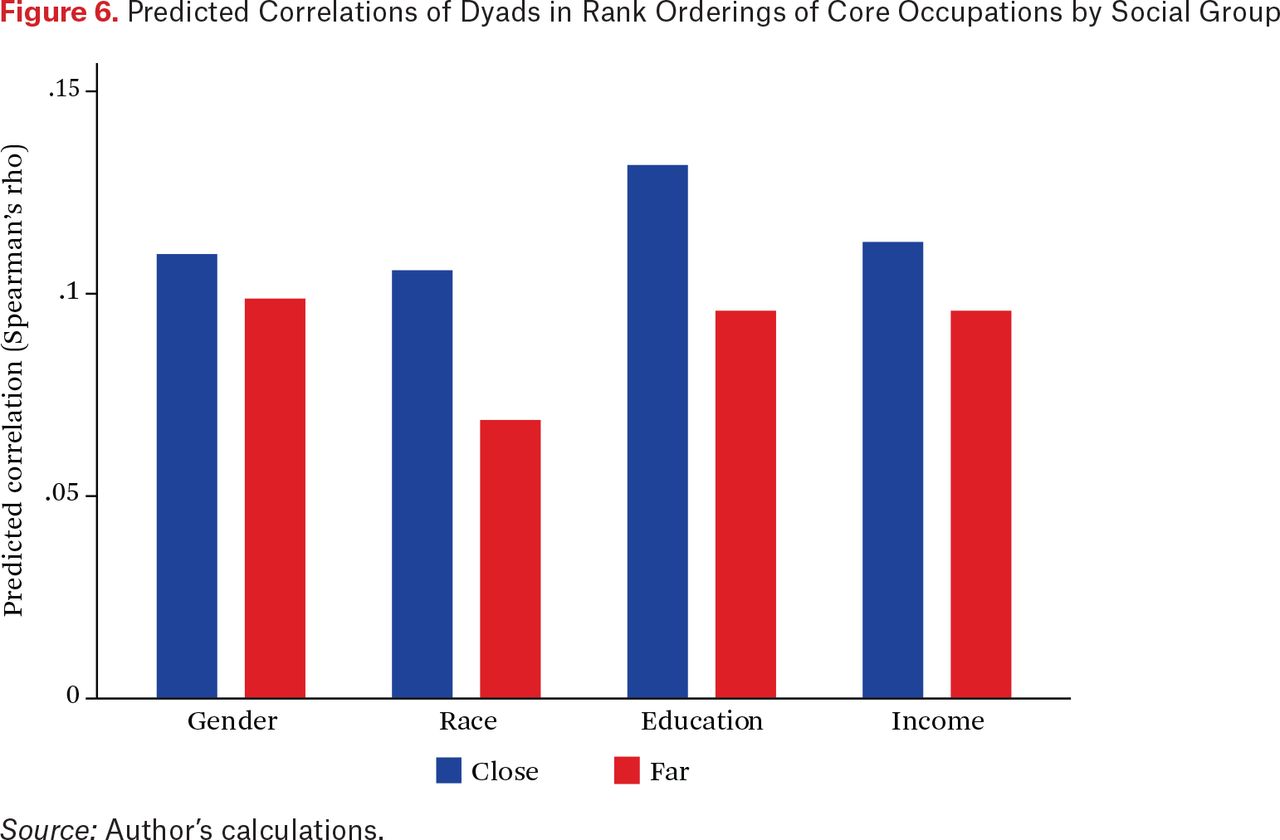
  • Predicted Correlations of Dyads in Rank Orderings of Core Occupations by Social Group Source: Author’s calculations.
    • Download figure
    • Open in new tab
    • Download powerpoint
    Figure 6.

    Predicted Correlations of Dyads in Rank Orderings of Core Occupations by Social Group

    Source: Author’s calculations.

  • Descriptive Differences in Kendall’s tau (a) Correlations by Dyad Source: Author’s calculations.
    • Download figure
    • Open in new tab
    • Download powerpoint
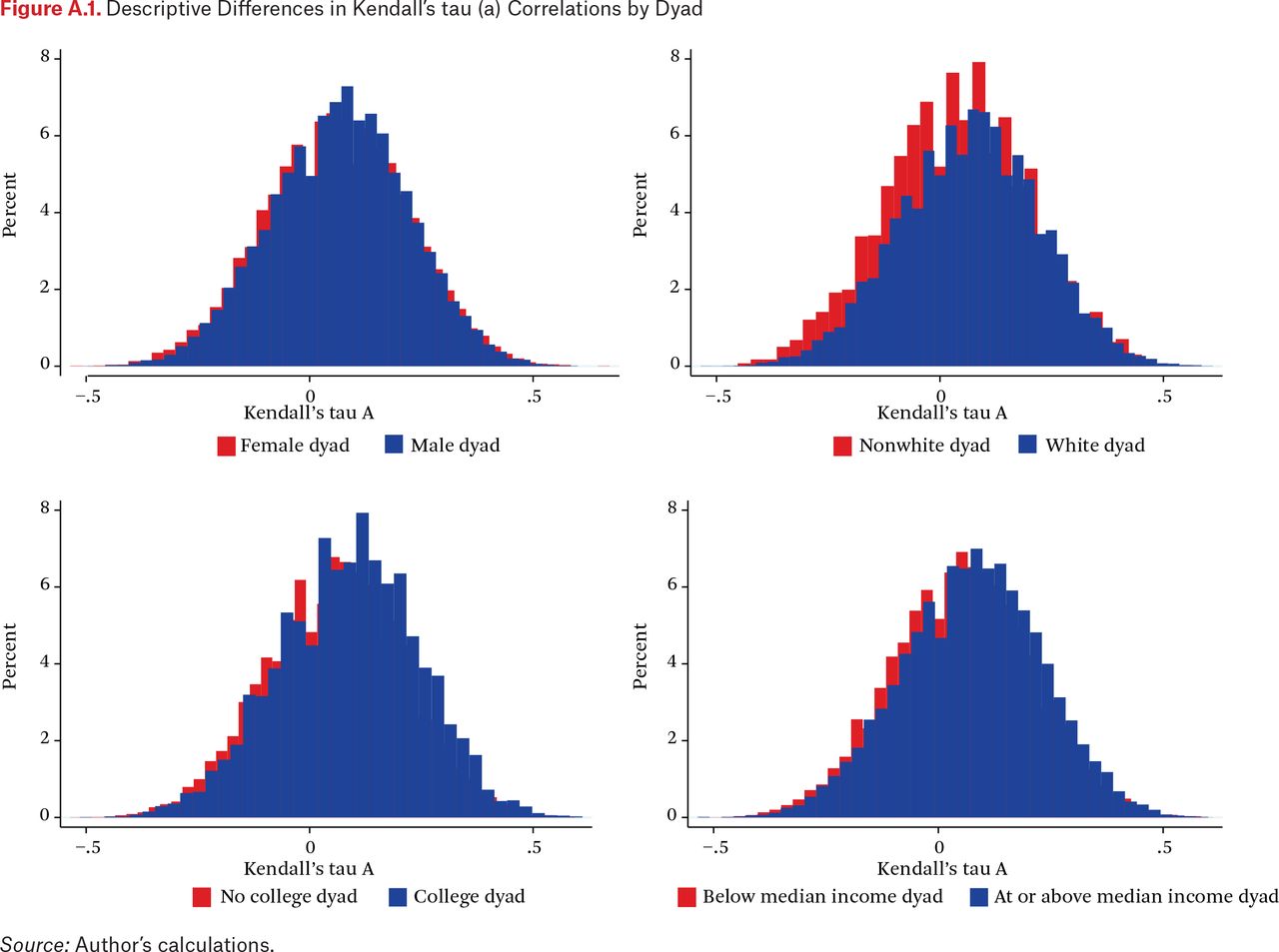
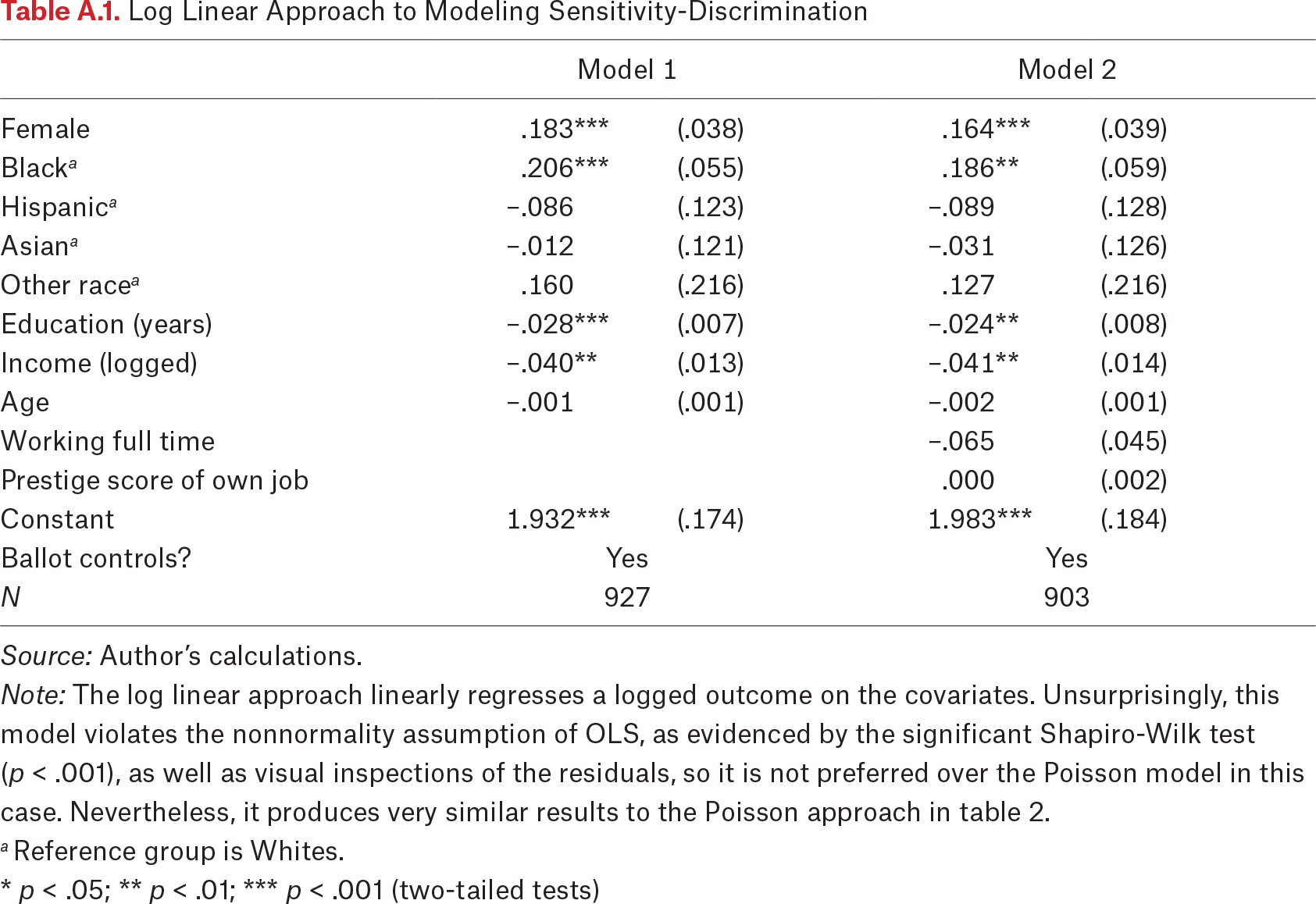
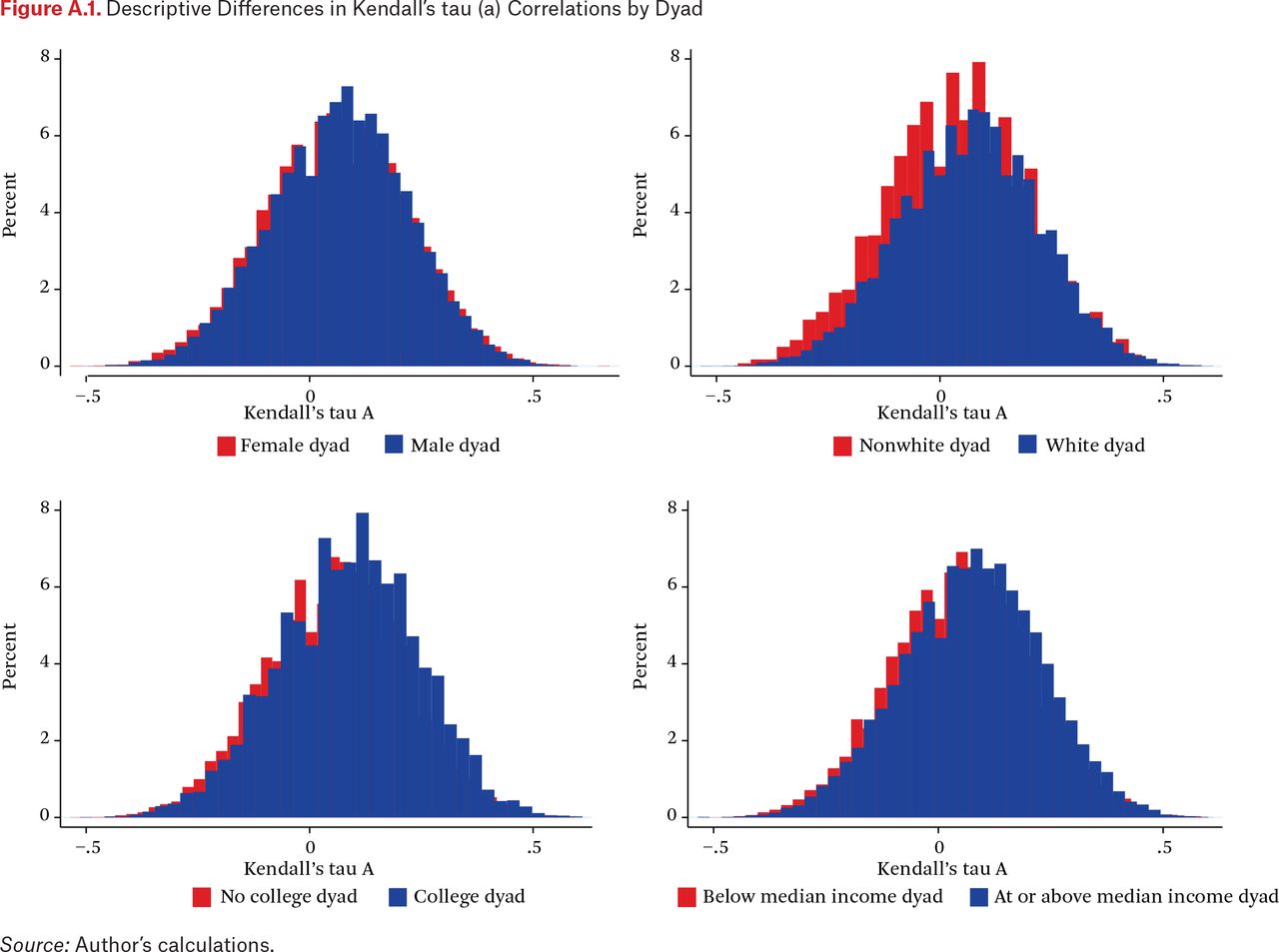
    Figure A.1.

    Descriptive Differences in Kendall’s tau (a) Correlations by Dyad

    Source: Author’s calculations.

  • Descriptive Differences in Kendall’s tau (b) Correlations by Dyad Source: Author’s calculations.
    • Download figure
    • Open in new tab
    • Download powerpoint
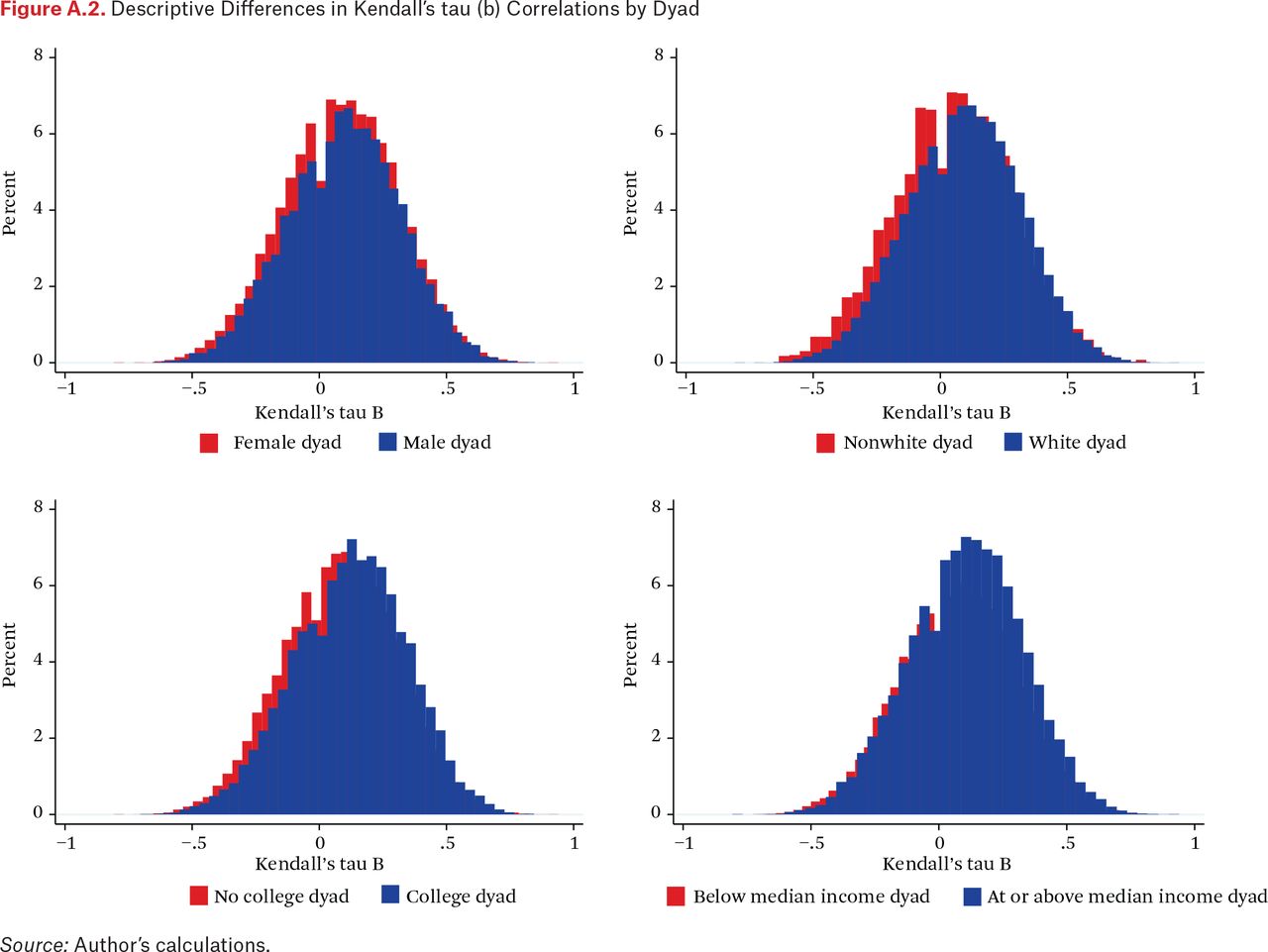
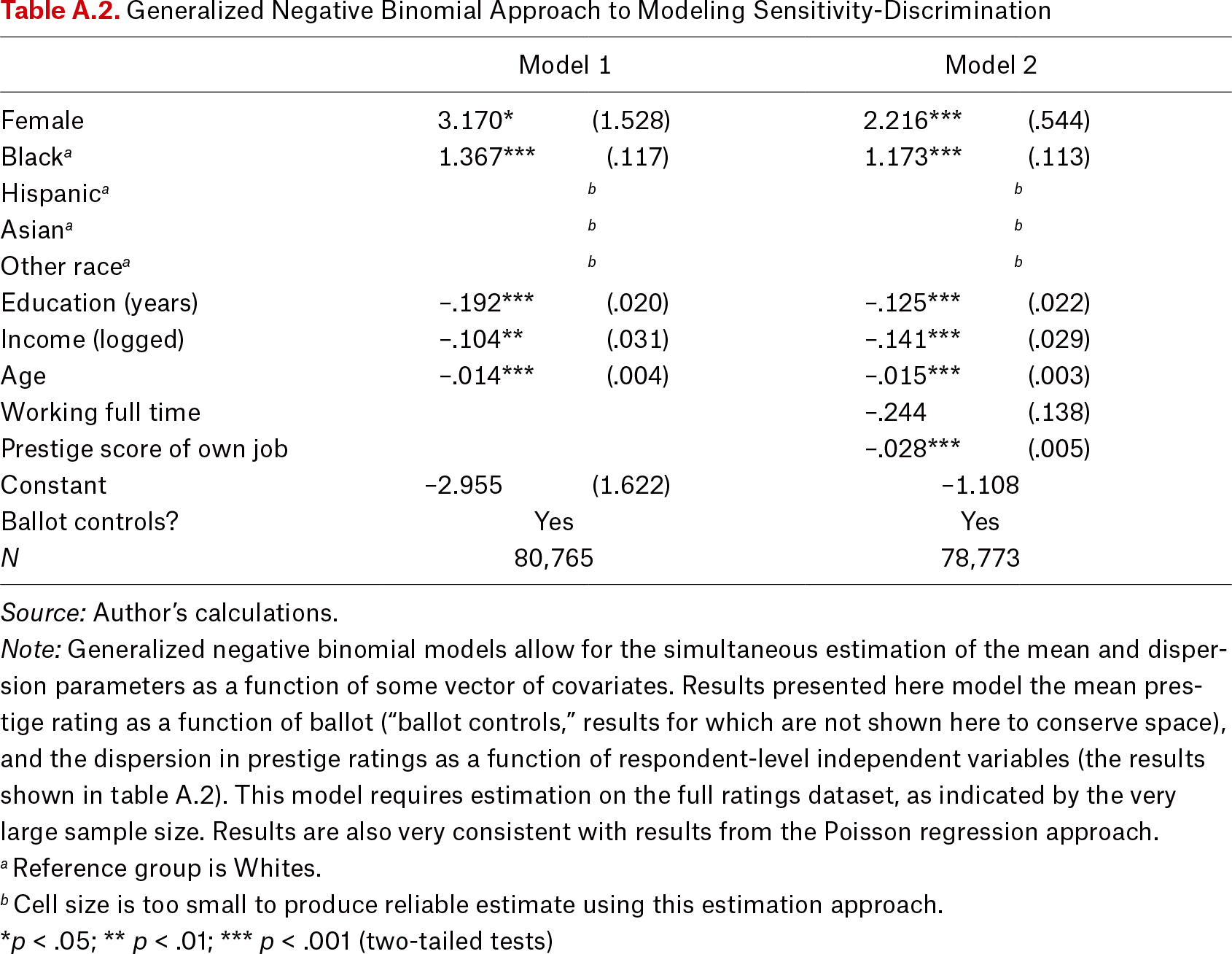
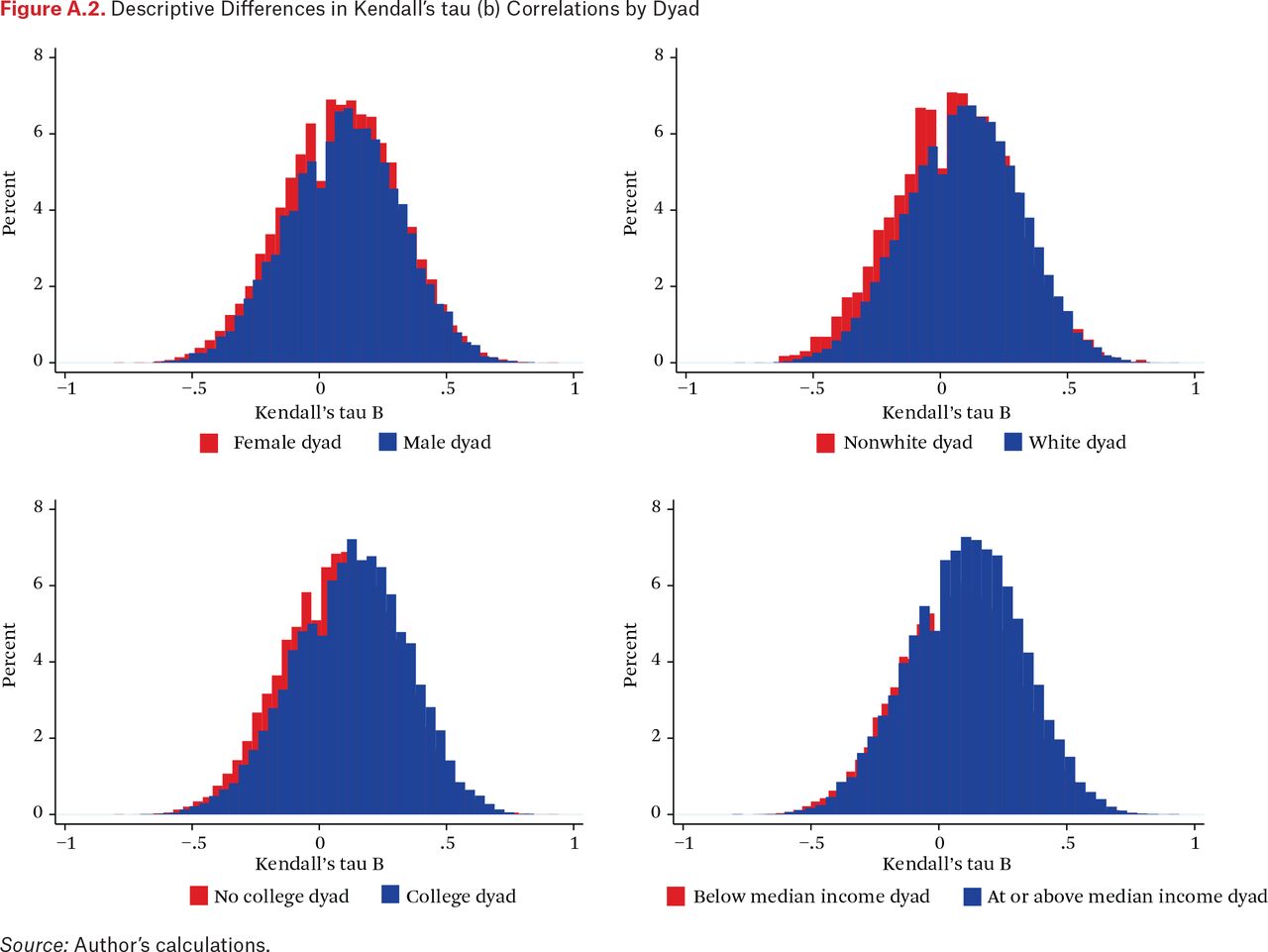
    Figure A.2.

    Descriptive Differences in Kendall’s tau (b) Correlations by Dyad

    Source: Author’s calculations.

  • Predicted Values for Kendall’s tau (a) by Social Group Source: Author’s calculations.
    • Download figure
    • Open in new tab
    • Download powerpoint
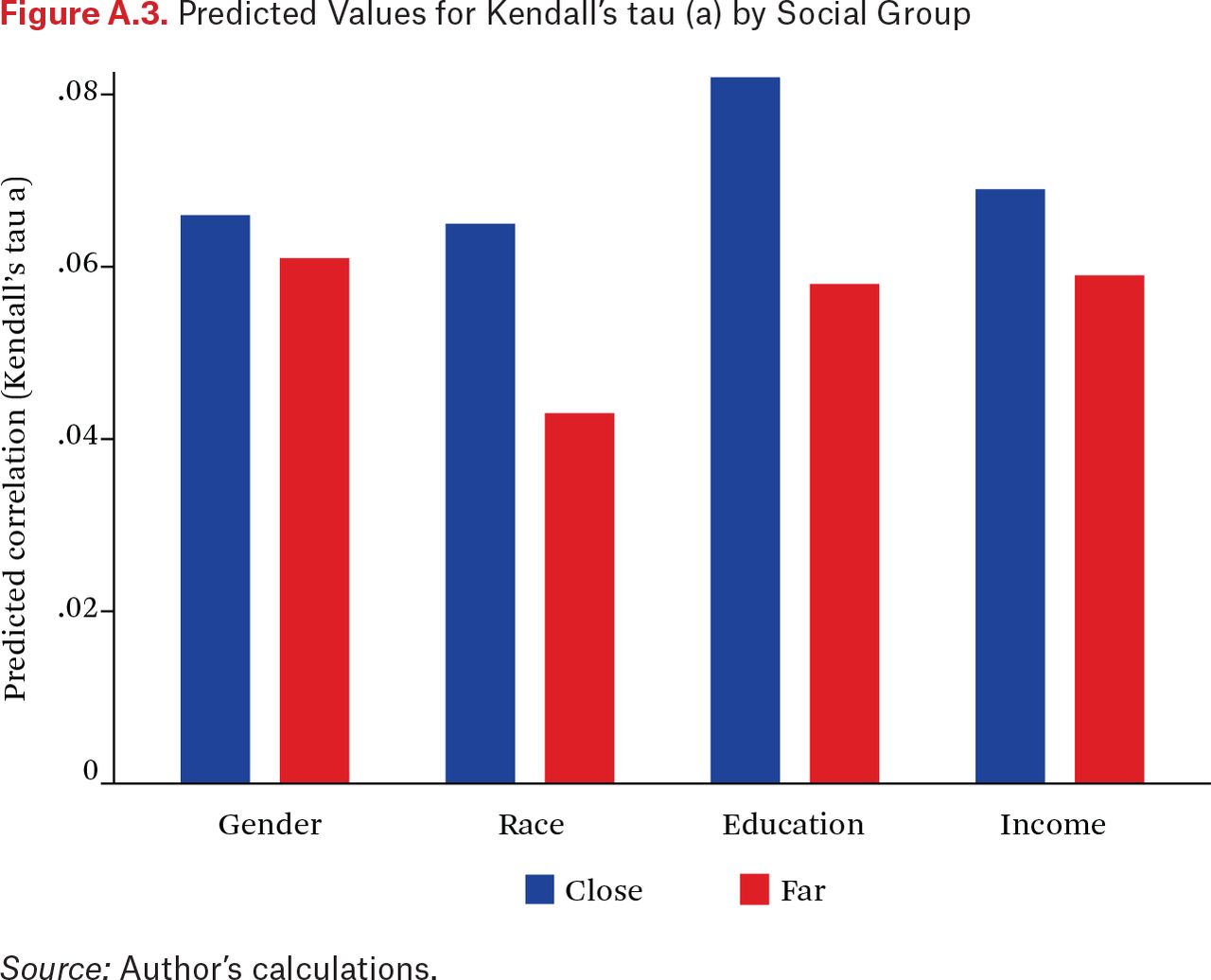
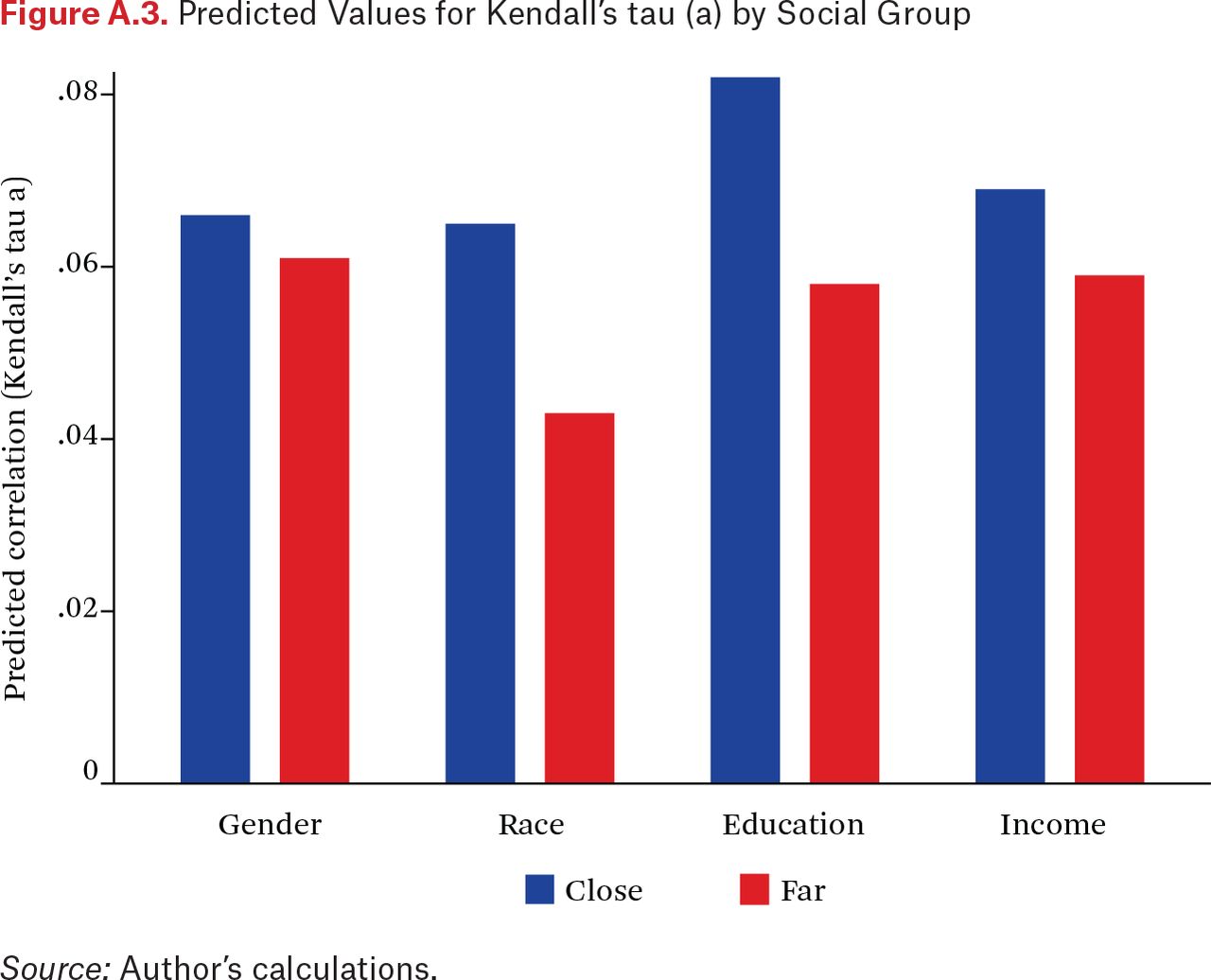
    Figure A.3.

    Predicted Values for Kendall’s tau (a) by Social Group

    Source: Author’s calculations.

  • Predicted Values for Kendall’s tau (b) by Social Group Source: Author’s calculations. Taken together, Figures A.1 through A.4 demonstrate that results presented for dyadic correlations of rank orderings are not sensitive to the measure of ordinal correlation used because they are consistent across all three measures (Spearman’s ρ, Kendall’s τ a and Kendall’s τ b).
    • Download figure
    • Open in new tab
    • Download powerpoint
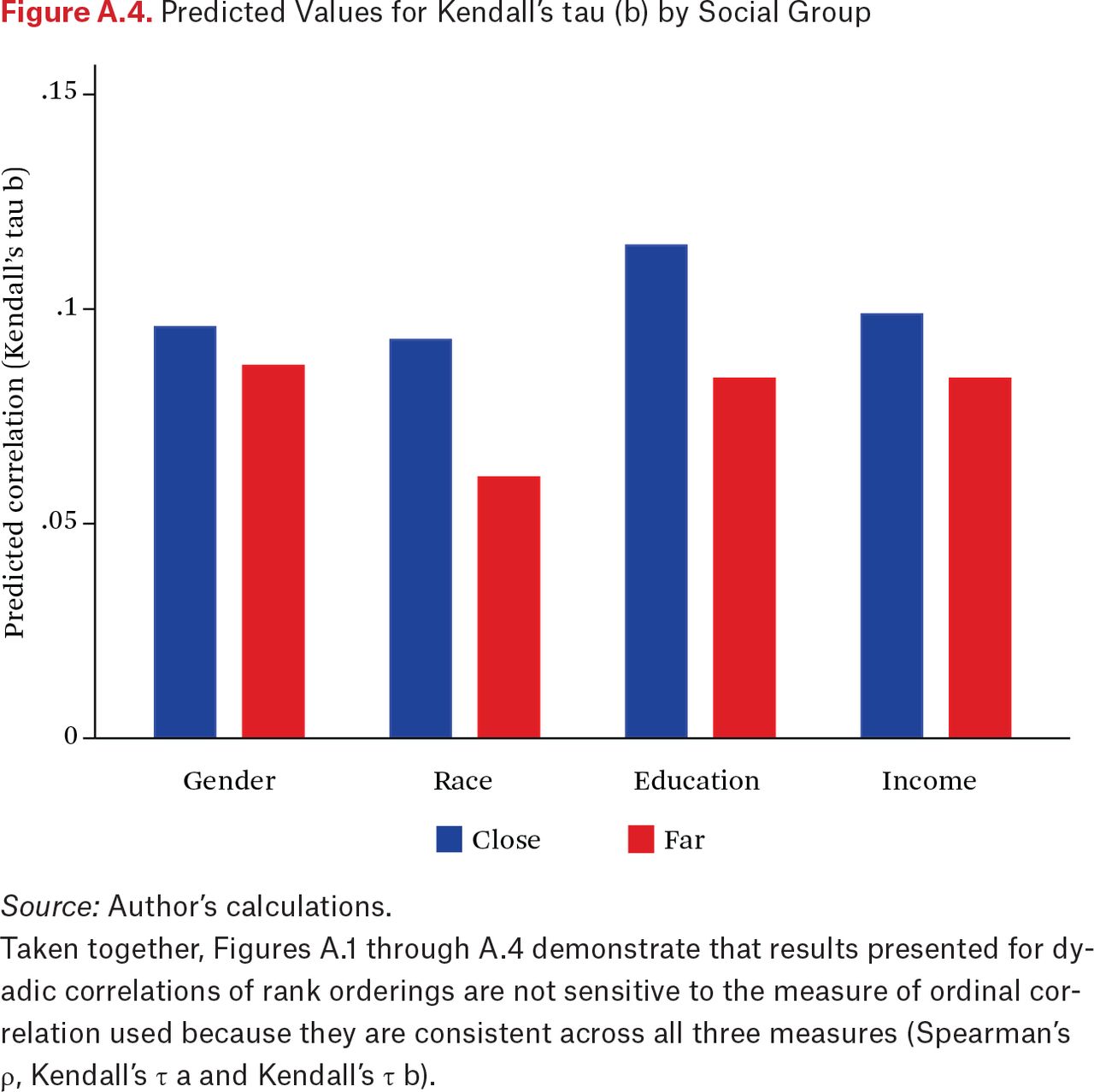
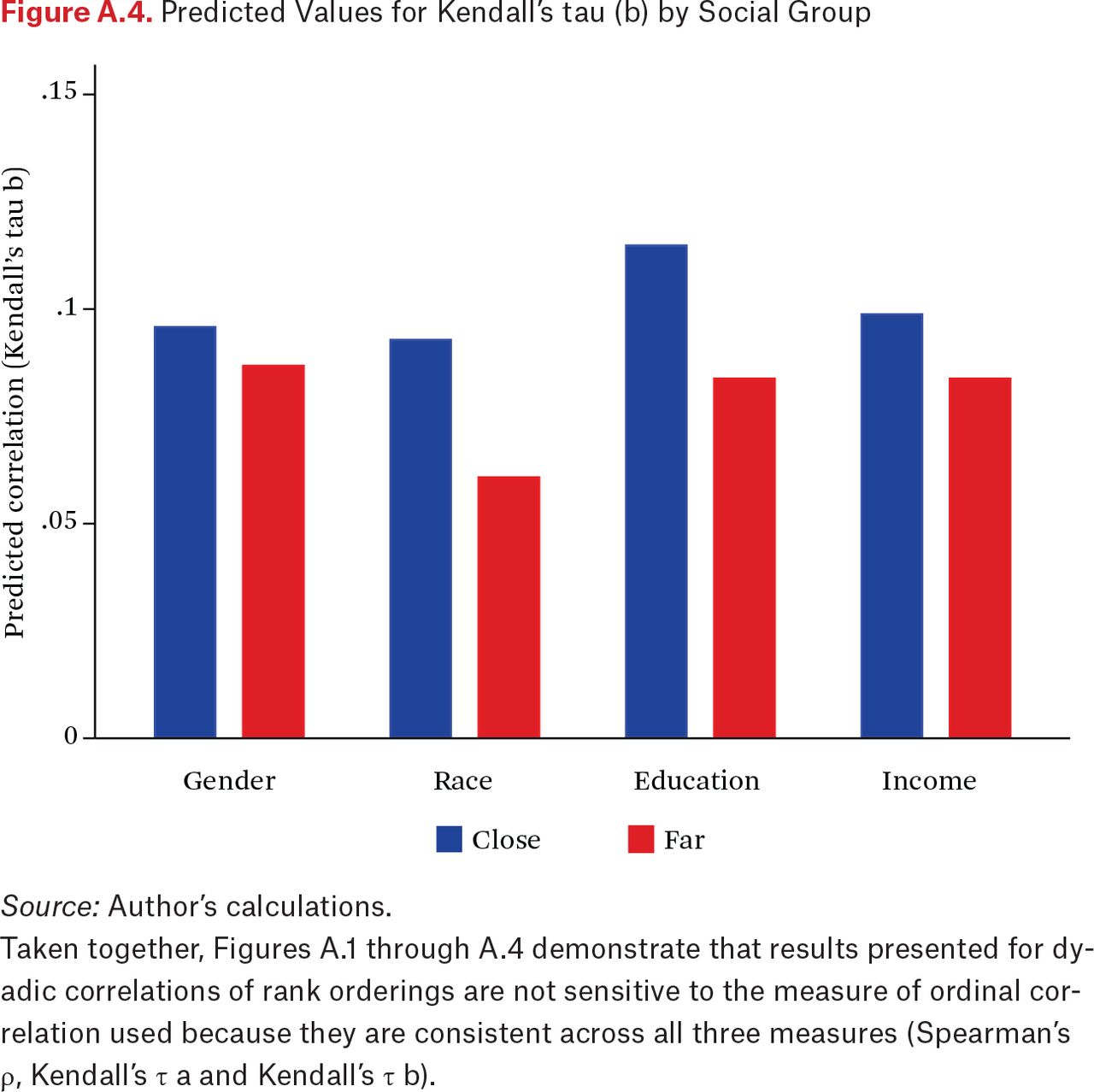
    Figure A.4.

    Predicted Values for Kendall’s tau (b) by Social Group

    Source: Author’s calculations.

    Taken together, Figures A.1 through A.4 demonstrate that results presented for dyadic correlations of rank orderings are not sensitive to the measure of ordinal correlation used because they are consistent across all three measures (Spearman’s ρ, Kendall’s τ a and Kendall’s τ b).

Tables
  • Figures
  • Table
  • Table
  • Table
  • Table
  • Table
PreviousNext
Back to top

In this issue

RSF: The Russell Sage Foundation Journal of the Social Sciences: 8 (7)
RSF: The Russell Sage Foundation Journal of the Social Sciences
Vol. 8, Issue 7
1 Nov 2022
  • Table of Contents
  • Table of Contents (PDF)
  • Cover (PDF)
  • Index by author
  • Front Matter (PDF)
Print
Download PDF
Email Article

Thank you for your interest in spreading the word on RSF: The Russell Sage Foundation Journal of the Social Sciences.

NOTE: We only request your email address so that the person you are recommending the page to knows that you wanted them to see it, and that it is not junk mail. We do not capture any email address.

Enter multiple addresses on separate lines or separate them with commas.
Status Lenses: Mapping Hierarchy and Consensus in Status Beliefs
(Your Name) has sent you a message from RSF: The Russell Sage Foundation Journal of the Social Sciences
(Your Name) thought you would like to see the RSF: The Russell Sage Foundation Journal of the Social Sciences web site.
CAPTCHA
This question is for testing whether or not you are a human visitor and to prevent automated spam submissions.
14 + 5 =
Solve this simple math problem and enter the result. E.g. for 1+3, enter 4.
Citation Tools
Status Lenses: Mapping Hierarchy and Consensus in Status Beliefs
Lauren Valentino
RSF: The Russell Sage Foundation Journal of the Social Sciences Nov 2022, 8 (7) 89-110; DOI: 10.7758/RSF.2022.8.7.05

Citation Manager Formats

  • BibTeX
  • Bookends
  • EasyBib
  • EndNote (tagged)
  • EndNote 8 (xml)
  • Medlars
  • Mendeley
  • Papers
  • RefWorks Tagged
  • Ref Manager
  • RIS
  • Zotero
Share
Status Lenses: Mapping Hierarchy and Consensus in Status Beliefs
Lauren Valentino
RSF: The Russell Sage Foundation Journal of the Social Sciences Nov 2022, 8 (7) 89-110; DOI: 10.7758/RSF.2022.8.7.05
del.icio.us logo Twitter logo Facebook logo Mendeley logo
  • Tweet Widget
  • Facebook Like
  • Google Plus One

Jump to section

  • Article
    • Abstract
    • SHAREDNESS IN STATUS PERCEPTIONS
    • STATUS LENSES
    • DATA AND METHODS
    • FINDINGS
    • DISCUSSION AND CONCLUSION
    • Appendices
    • FOOTNOTES
    • REFERENCES
  • Figures & Data
  • Info & Metrics
  • References
  • PDF

Related Articles

  • No related articles found.
  • Google Scholar

Cited By...

  • No citing articles found.
  • Google Scholar

More in this TOC Section

  • Do Perceptions of Privilege Enhance—or Impede—Perceptions of Intelligence? Evidence from a National Survey Experiment
  • Status as Deference: Cultural Meaning as a Source of Occupational Behavior
Show more II. Status Is Relational, Cultural, and Multilevel

Similar Articles

Keywords

  • status
  • inequality
  • occupational prestige

© 2026 RSF: The Russell Sage Foundation Journal of the Social Sciences

Powered by HighWire