Main menu

  • Foundation Website
  • Journal Home
  • Issues
    • Current Issue
    • All Issues
    • Future Issues
  • For Authors and Editors
    • Overview of RSF & How to Propose an Issue
    • RSF Style and Submission Guidelines
    • Article Submission Checklist
    • Permission Request
    • Terms of Contributor Agreement Form and Transfer of Copyright
    • RSF Contributor Agreement Form
    • Issue Editors' Agreement Form
  • About the Journal
    • Mission Statement
    • Editorial Board
    • Comments and Replies Policy
    • Journal Code of Ethics
    • Current Calls for Articles
    • Closed Calls for Articles
    • Abstracting and Indexing
    • Privacy Policy
    • Copyright and ISSN Information
    • Terms of Use
    • Contact Us
  • Publications
    • rsf

User menu

  • Log in

Search

  • Advanced search
RSF: The Russell Sage Foundation Journal of the Social Sciences
  • Publications
    • rsf
  • Log in
RSF: The Russell Sage Foundation Journal of the Social Sciences

Advanced Search

  • Foundation Website
  • Journal Home
  • Issues
    • Current Issue
    • All Issues
    • Future Issues
  • For Authors and Editors
    • Overview of RSF & How to Propose an Issue
    • RSF Style and Submission Guidelines
    • Article Submission Checklist
    • Permission Request
    • Terms of Contributor Agreement Form and Transfer of Copyright
    • RSF Contributor Agreement Form
    • Issue Editors' Agreement Form
  • About the Journal
    • Mission Statement
    • Editorial Board
    • Comments and Replies Policy
    • Journal Code of Ethics
    • Current Calls for Articles
    • Closed Calls for Articles
    • Abstracting and Indexing
    • Privacy Policy
    • Copyright and ISSN Information
    • Terms of Use
    • Contact Us
  • Follow rsf on Twitter
  • Visit rsf on Facebook
  • Follow rsf on Google Plus
Research ArticleIV. Child and Family Supports
Open Access

Administrative Burdens and Economic Insecurity Among Black, Latino, and White Families

Zachary Parolin, Christina J. Cross, Rourke O’Brien
RSF: The Russell Sage Foundation Journal of the Social Sciences September 2023, 9 (5) 56-75; DOI: https://doi.org/10.7758/RSF.2023.9.5.03
Zachary Parolin
aAssistant professor of social policy at Bocconi University in Milan, Italy
  • Find this author on Google Scholar
  • Find this author on PubMed
  • Search for this author on this site
  • ORCID record for Zachary Parolin
Christina J. Cross
bAssistant professor of sociology at Harvard University, United States
  • Find this author on Google Scholar
  • Find this author on PubMed
  • Search for this author on this site
Rourke O’Brien
cAssistant professor of sociology at Yale University, United States
  • Find this author on Google Scholar
  • Find this author on PubMed
  • Search for this author on this site
  • Article
  • Figures & Data
  • References
  • Info & Metrics
  • PDF
Loading

Article Figures & Data

Figures

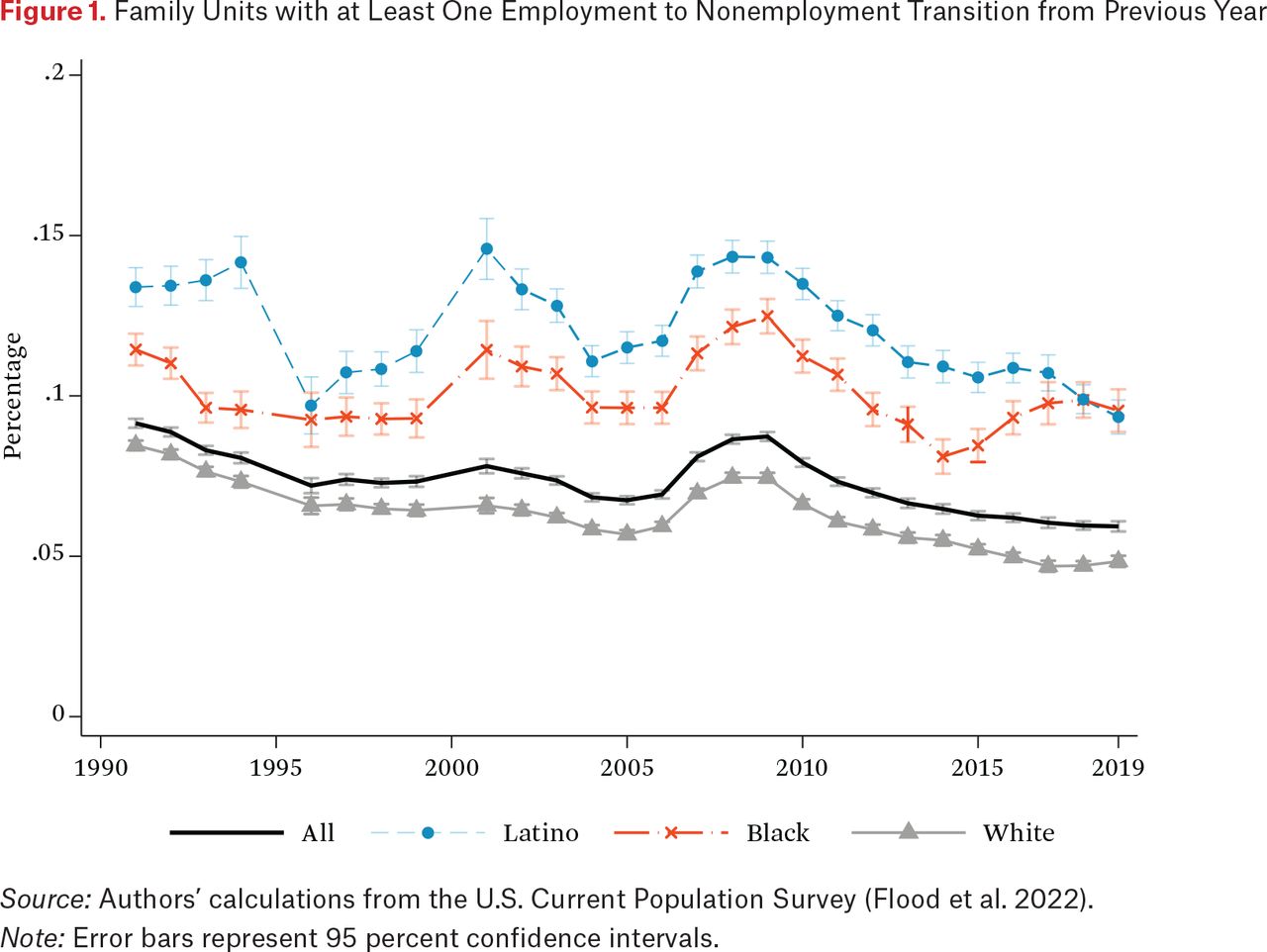
  • Figure 1.
    • Download figure
    • Open in new tab
    • Download powerpoint
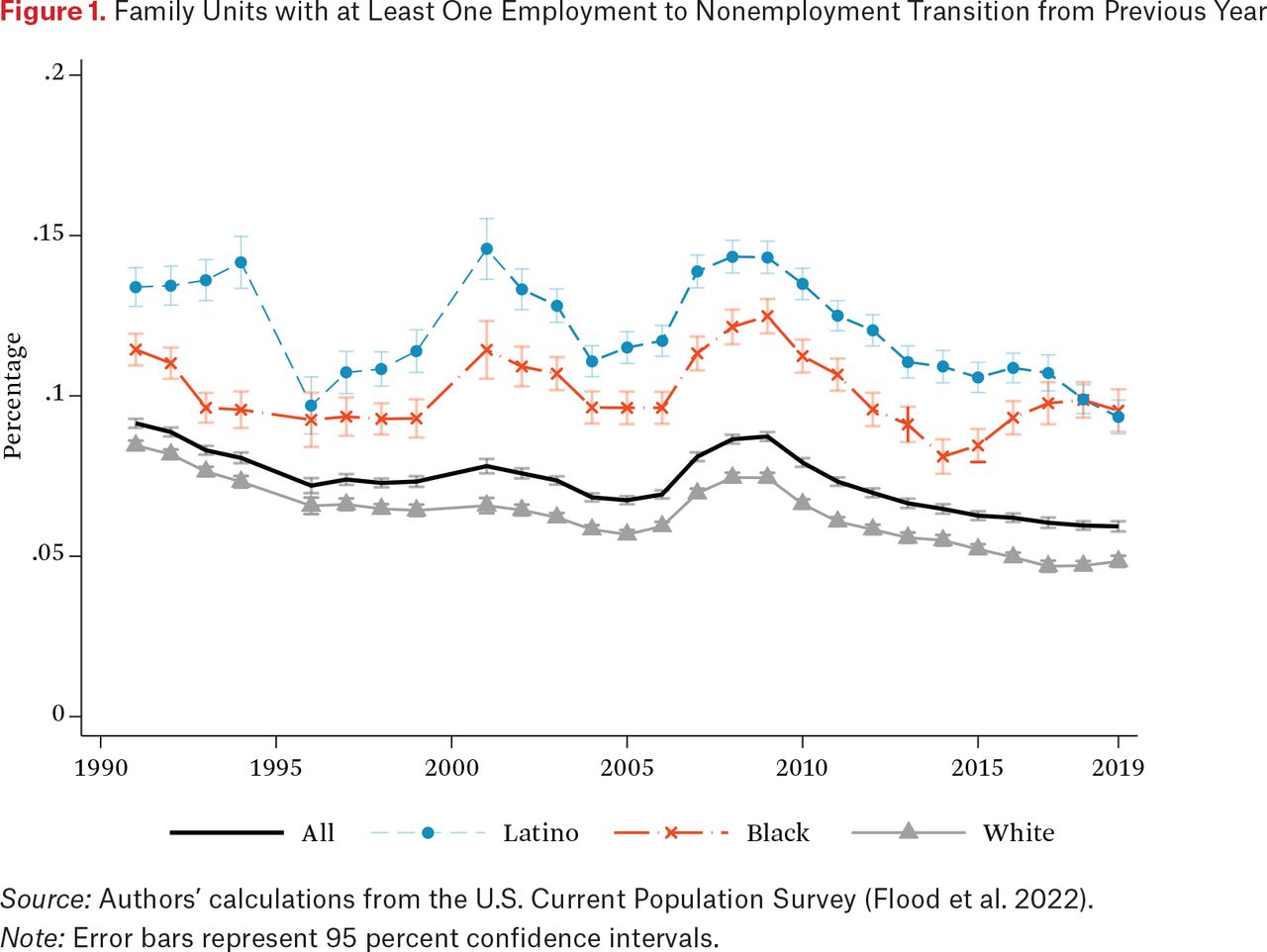
    Figure 1.

    Family Units with at Least One Employment to Nonemployment Transition from Previous Year

    Source: Authors’ calculations from the U.S. Current Population Survey (Flood et al. 2022).

    Note: Error bars represent 95 percent confidence intervals.

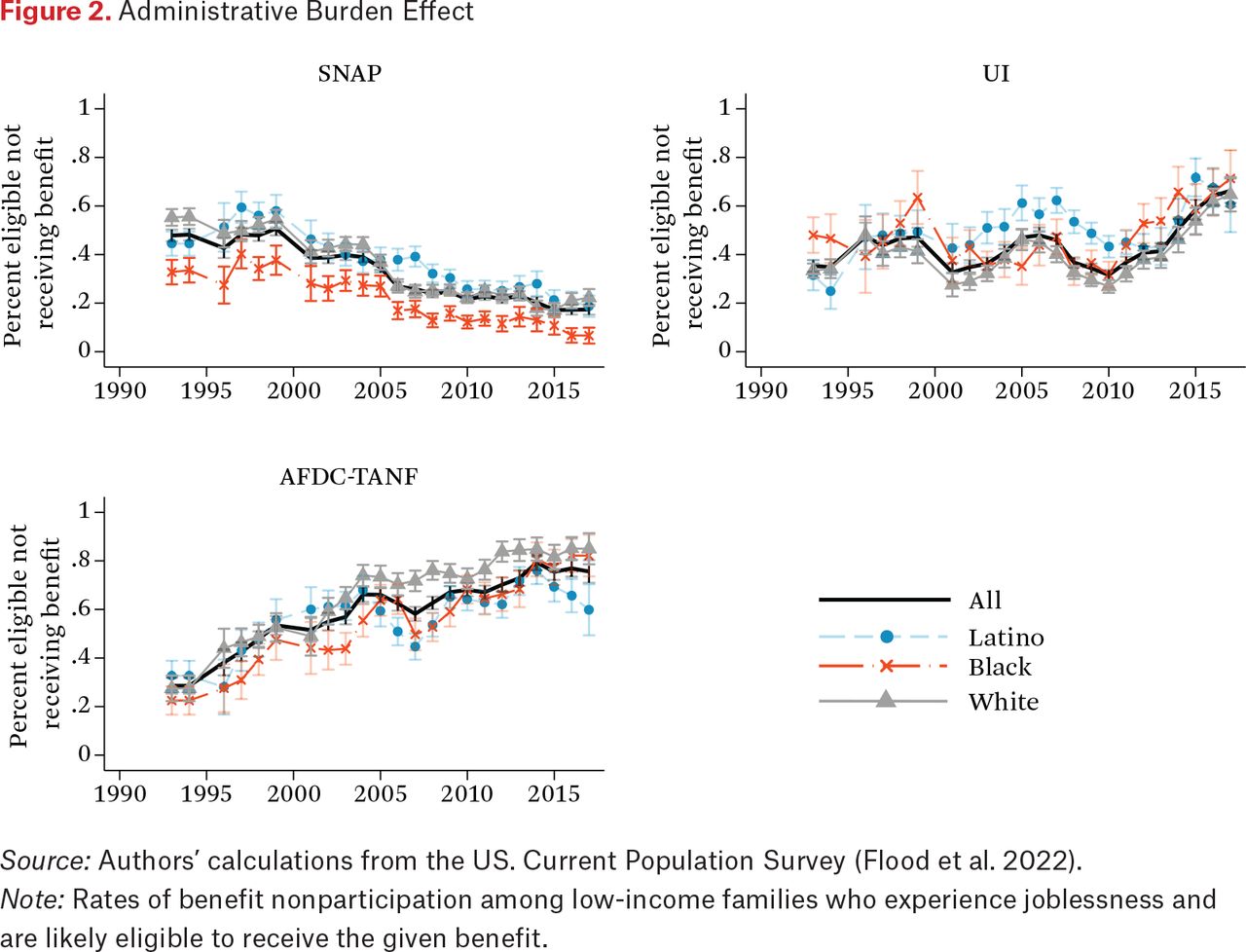
  • Figure 2.
    • Download figure
    • Open in new tab
    • Download powerpoint
    Figure 2.

    Administrative Burden Effect

    Source: Authors’ calculations from the US. Current Population Survey (Flood et al. 2022).

    Note: Rates of benefit nonparticipation among low-income families who experience joblessness and are likely eligible to receive the given benefit.

  • Figure 3.
    • Download figure
    • Open in new tab
    • Download powerpoint
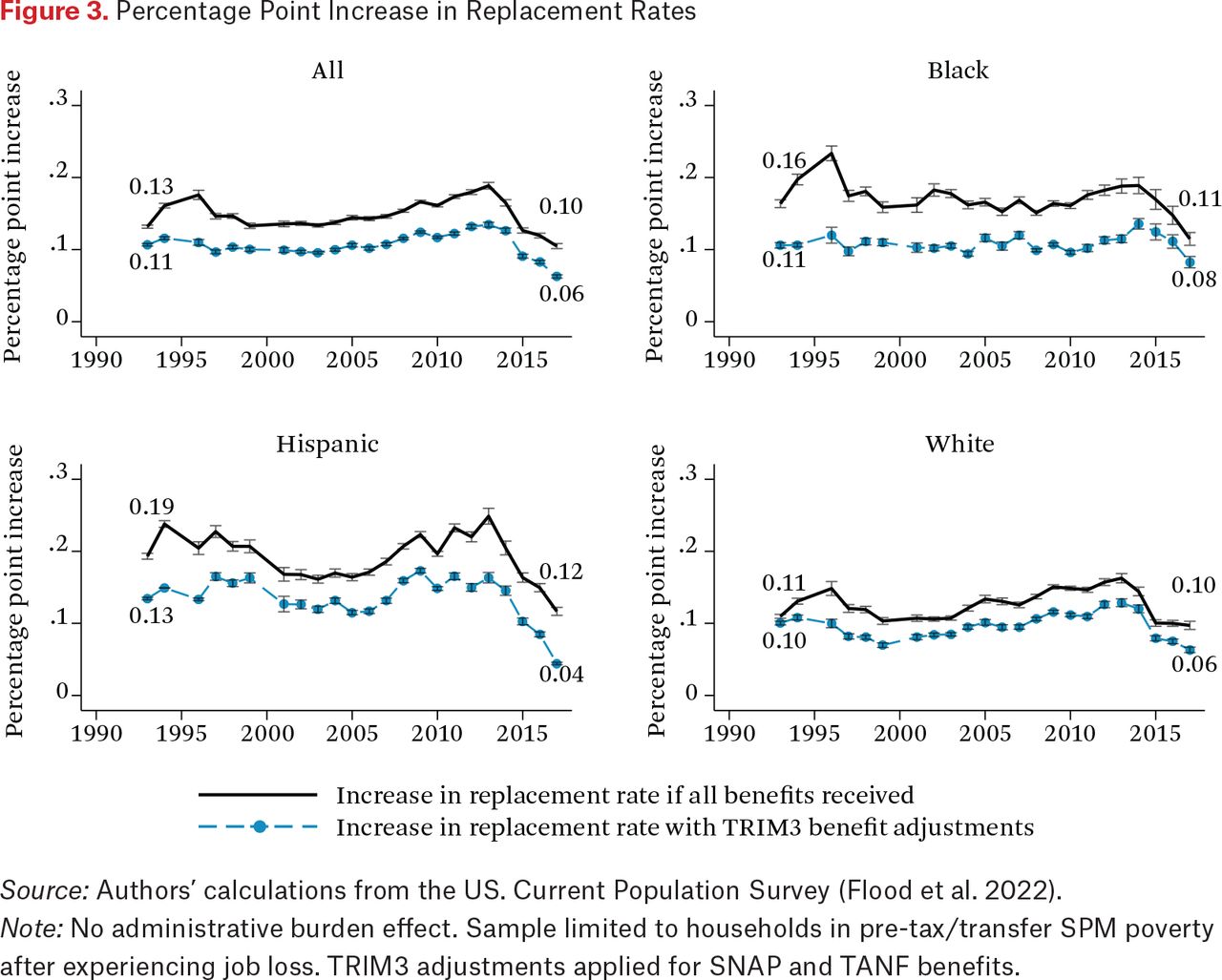
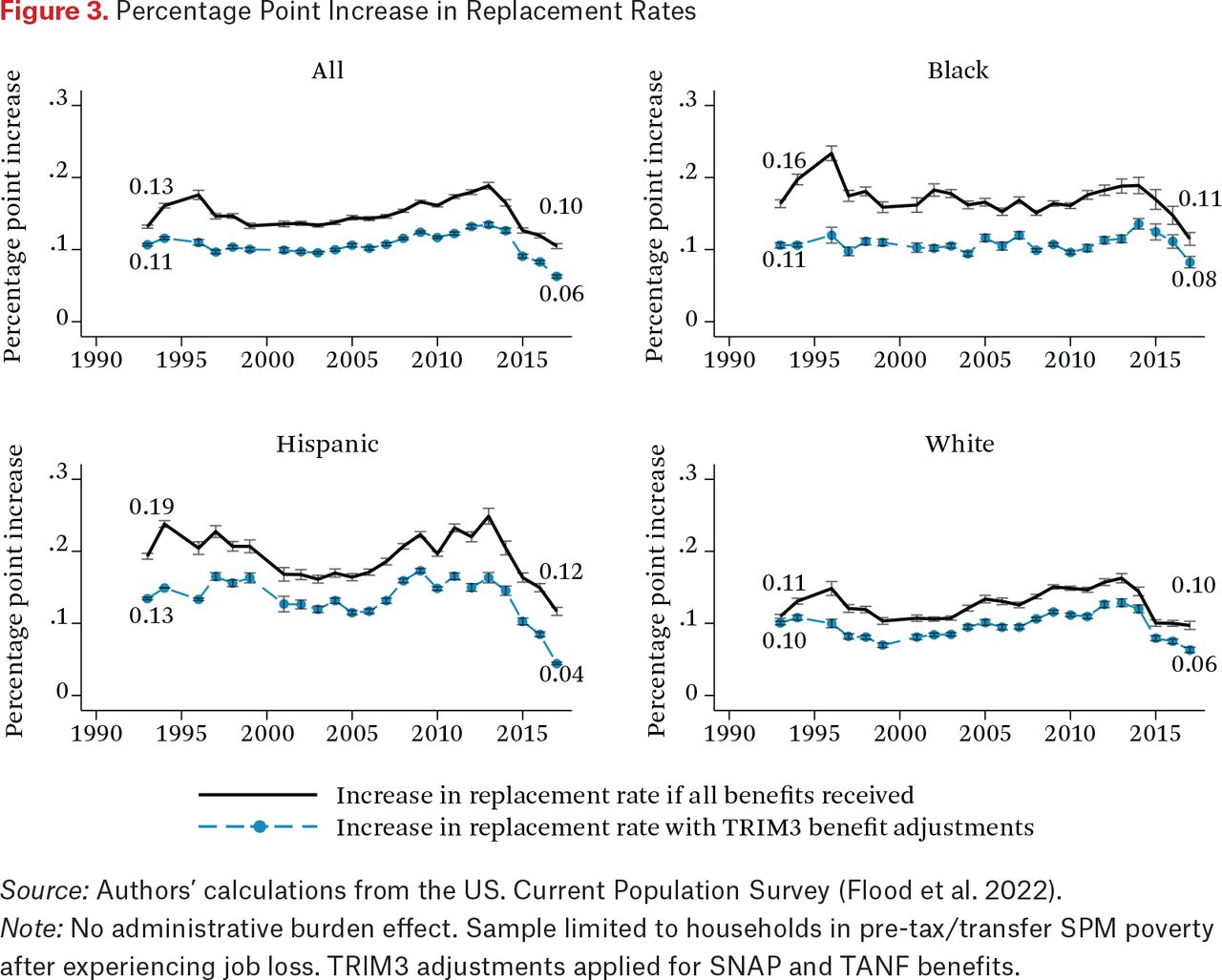
    Figure 3.

    Percentage Point Increase in Replacement Rates

    Source: Authors’ calculations from the US. Current Population Survey (Flood et al. 2022).

    Note: No administrative burden effect. Sample limited to households in pre-tax/transfer SPM poverty after experiencing job loss. TRIM3 adjustments applied for SNAP and TANF benefits.

  • Figure 4.
    • Download figure
    • Open in new tab
    • Download powerpoint
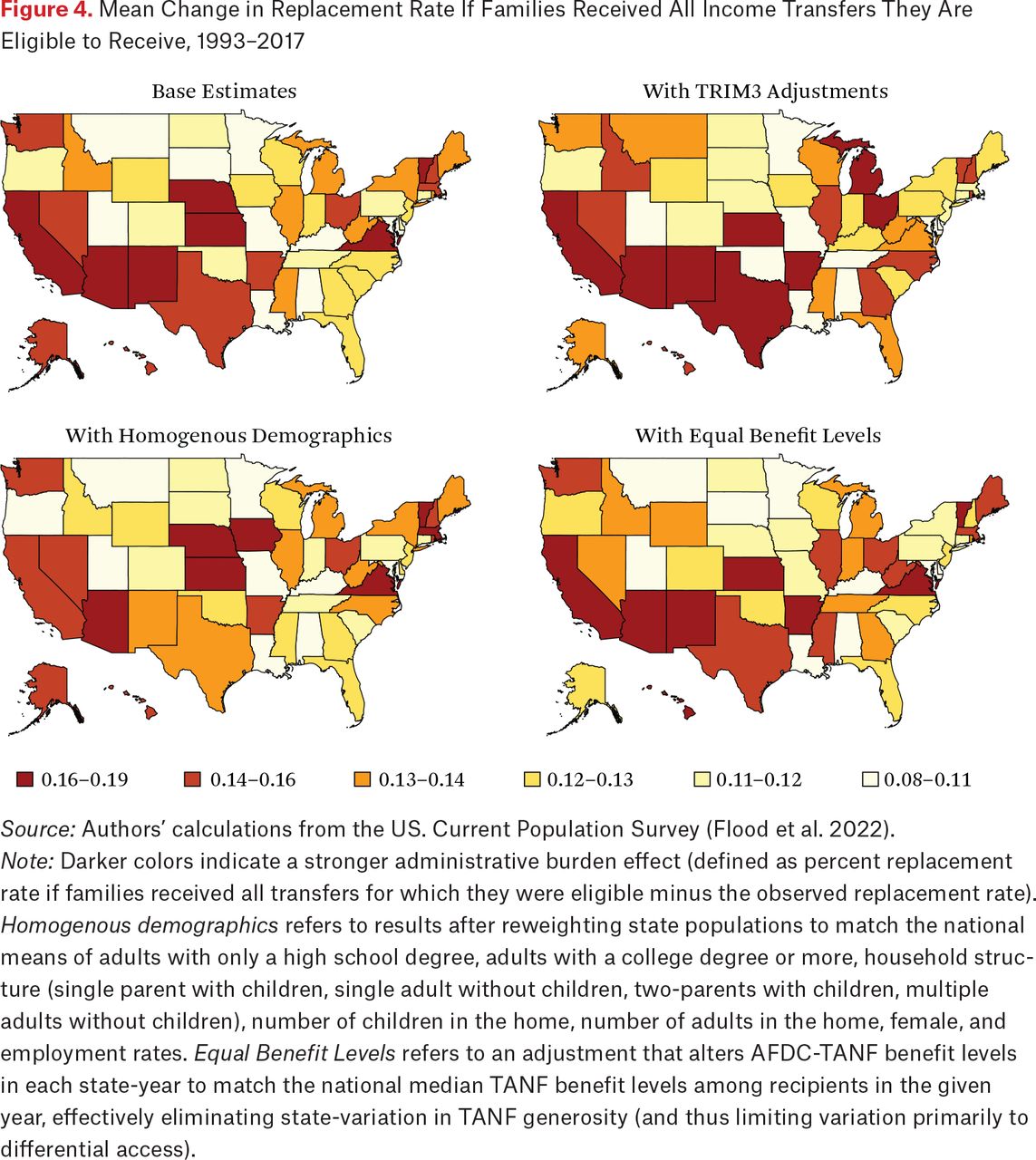
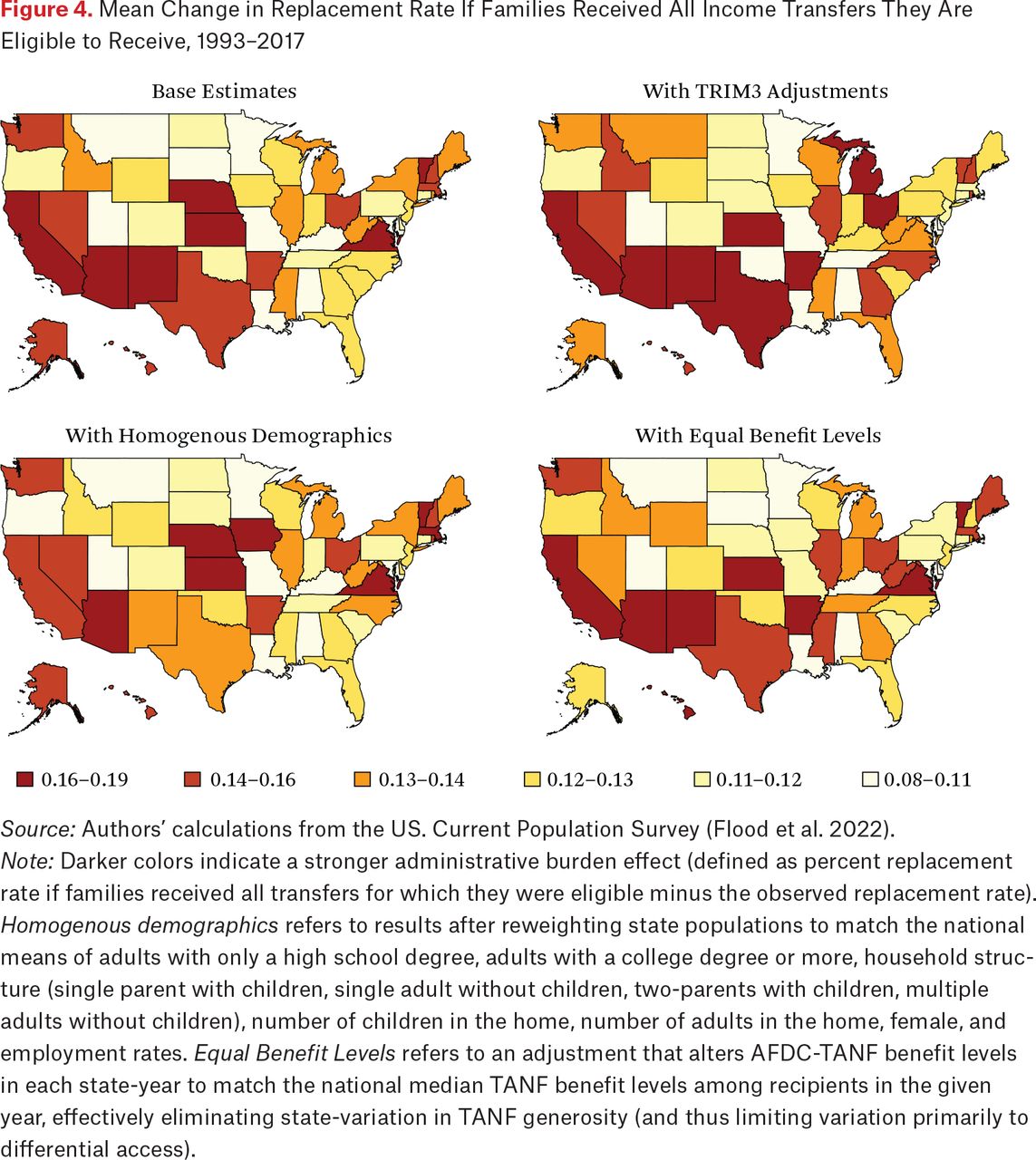
    Figure 4.

    Mean Change in Replacement Rate If Families Received All Income Transfers They Are Eligible to Receive, 1993–2017

    Source: Authors’ calculations from the US. Current Population Survey (Flood et al. 2022). Allow space for key in pagination

    Note: Darker colors indicate a stronger administrative burden effect (defined as percent replacement rate if families received all transfers for which they were eligible minus the observed replacement rate). Homogenous demographics refers to results after reweighting state populations to match the national means of adults with only a high school degree, adults with a college degree or more, household structure (single parent with children, single adult without children, two-parents with children, multiple adults without children), number of children in the home, number of adults in the home, female, and employment rates. Equal Benefit Levels refers to an adjustment that alters AFDC-TANF benefit levels in each state-year to match the national median TANF benefit levels among recipients in the given year, effectively eliminating state-variation in TANF generosity (and thus limiting variation primarily to differential access).

  • Figure 5.
    • Download figure
    • Open in new tab
    • Download powerpoint
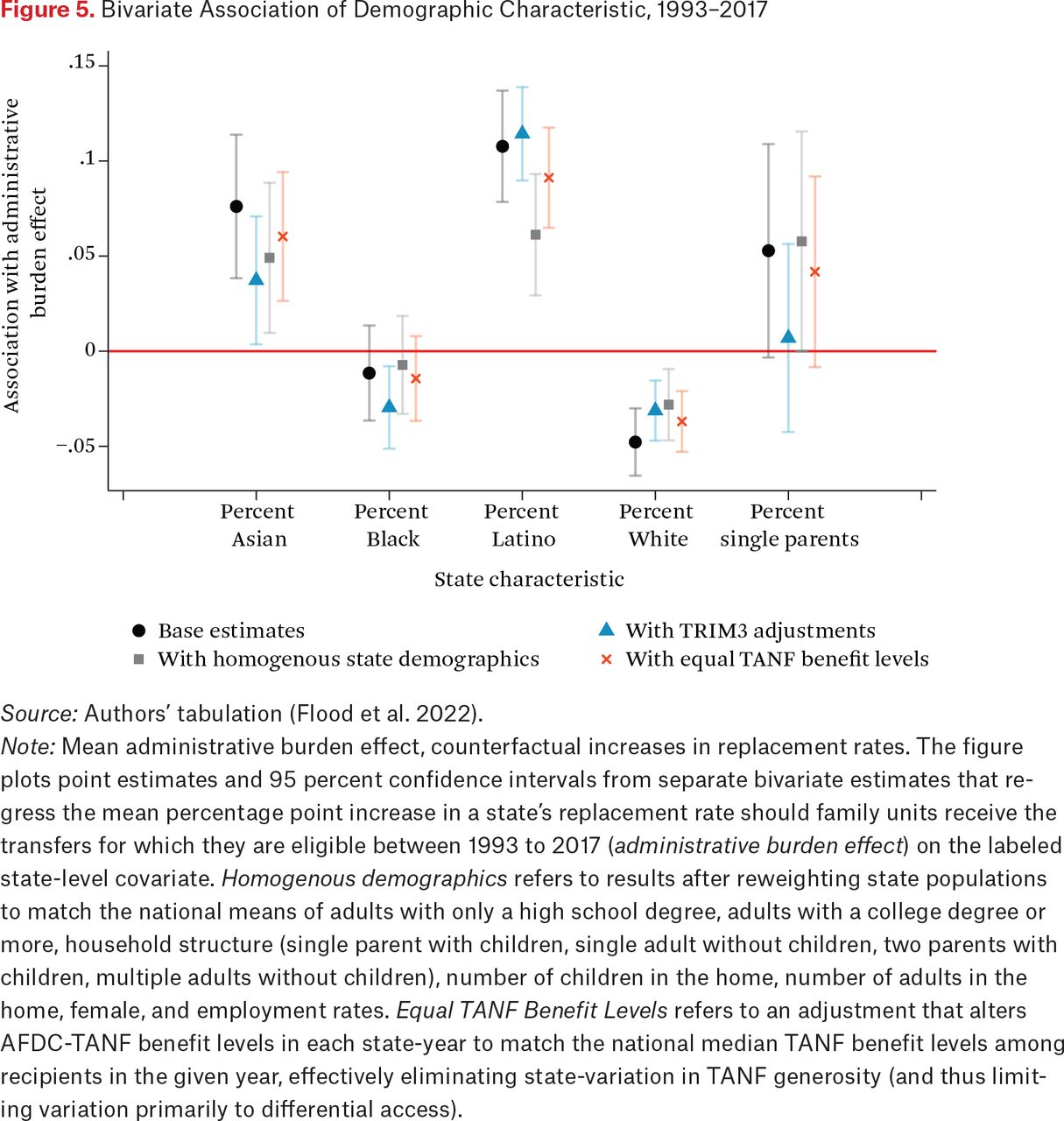
    Figure 5.

    Bivariate Association of Demographic Characteristic, 1993–2017

    Source: Authors’ tabulation (Flood et al. 2022).

    Note: Mean administrative burden effect, counterfactual increases in replacement rates. The figure plots point estimates and 95 percent confidence intervals from separate bivariate estimates that regress the mean percentage point increase in a state’s replacement rate should family units receive the transfers for which they are eligible between 1993 to 2017 (administrative burden effect) on the labeled state-level covariate. Homogenous demographics refers to results after reweighting state populations to match the national means of adults with only a high school degree, adults with a college degree or more, household structure (single parent with children, single adult without children, two parents with children, multiple adults without children), number of children in the home, number of adults in the home, female, and employment rates. Equal TANF Benefit Levels refers to an adjustment that alters AFDC-TANF benefit levels in each state-year to match the national median TANF benefit levels among recipients in the given year, effectively eliminating state-variation in TANF generosity (and thus limiting variation primarily to differential access).

  • Figure A.1.
    • Download figure
    • Open in new tab
    • Download powerpoint
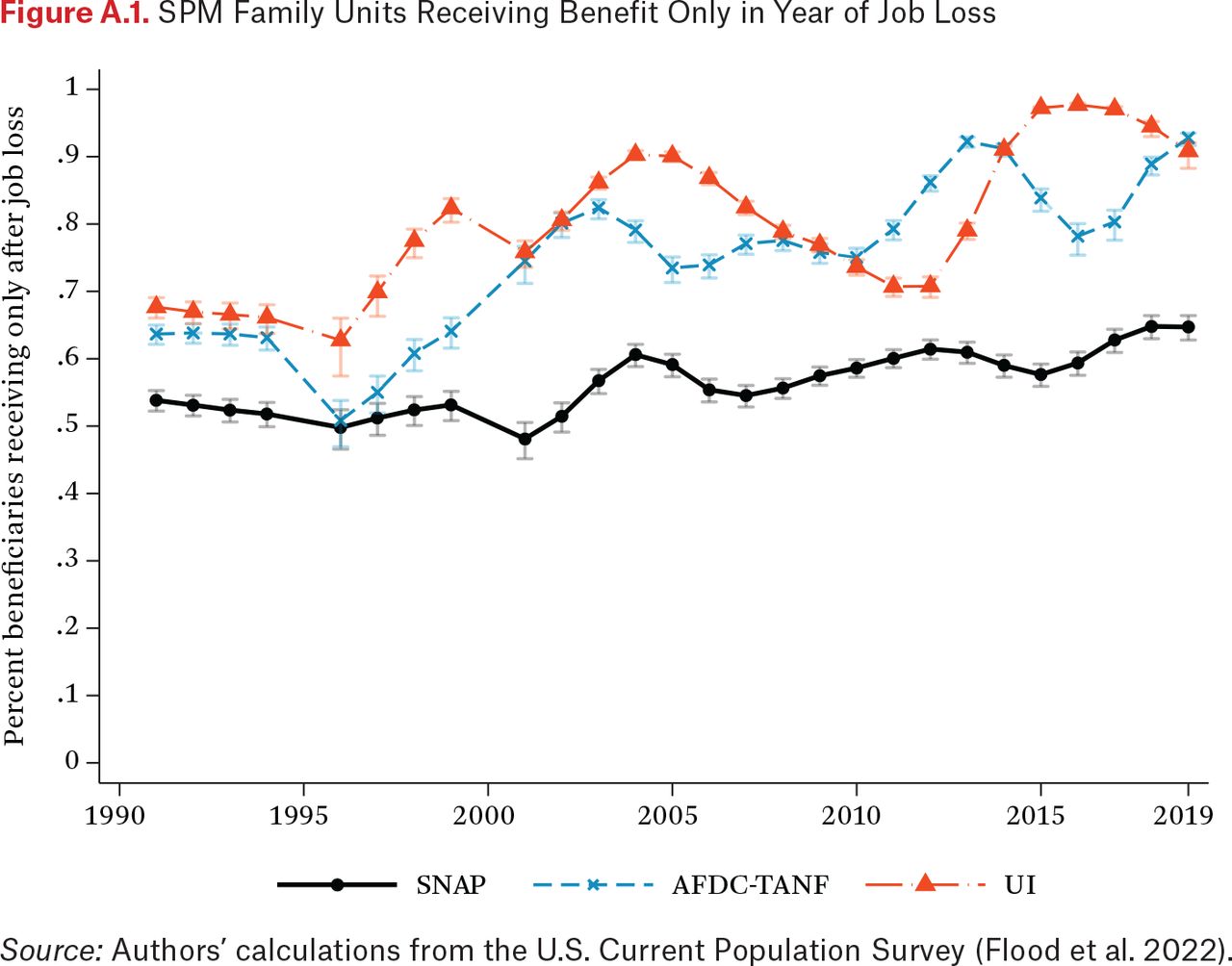
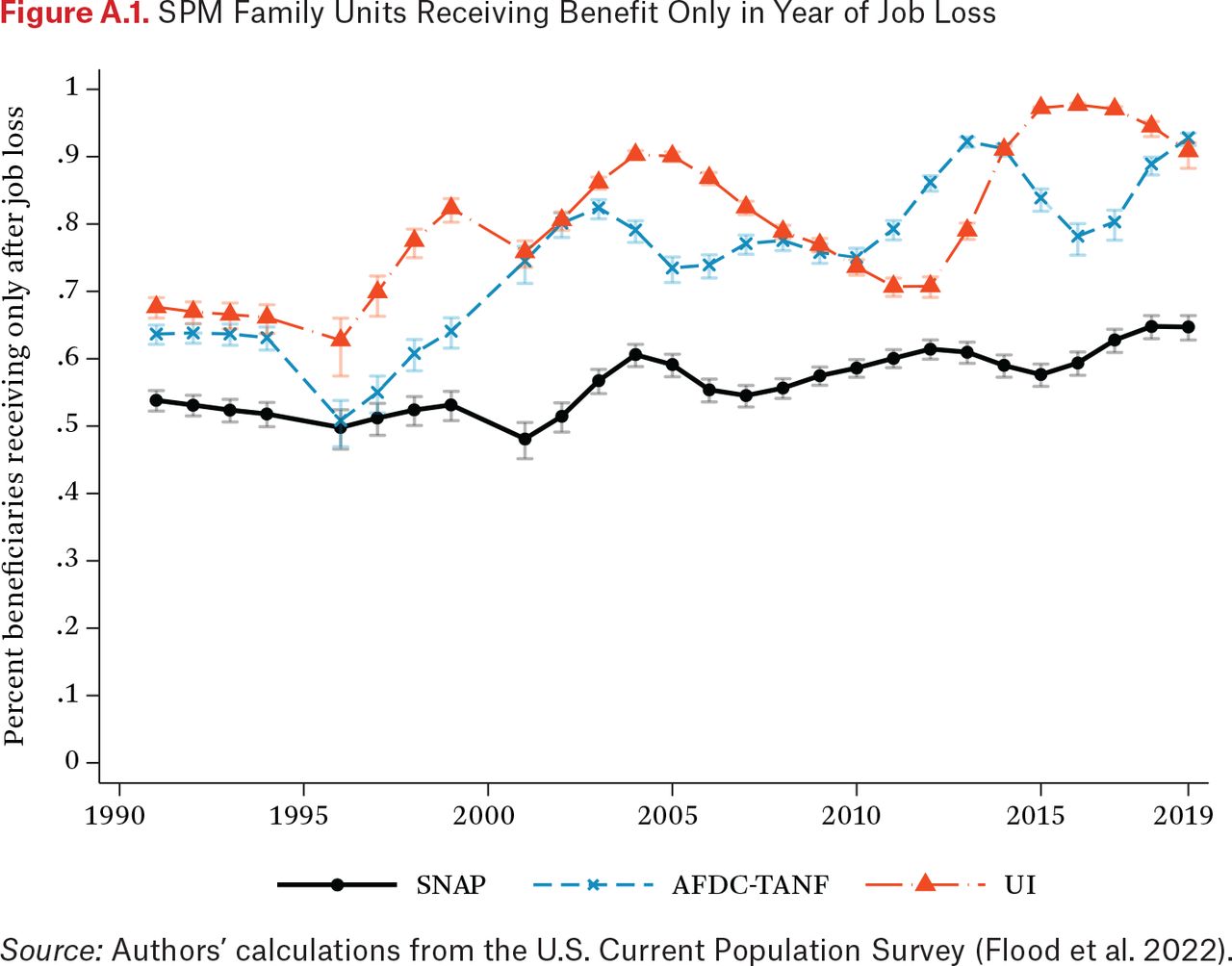
    Figure A.1.

    SPM Family Units Receiving Benefit Only in Year of Job Loss

    Source: Authors’ calculations from the U.S. Current Population Survey (Flood et al. 2022).

  • Figure A.2.
    • Download figure
    • Open in new tab
    • Download powerpoint
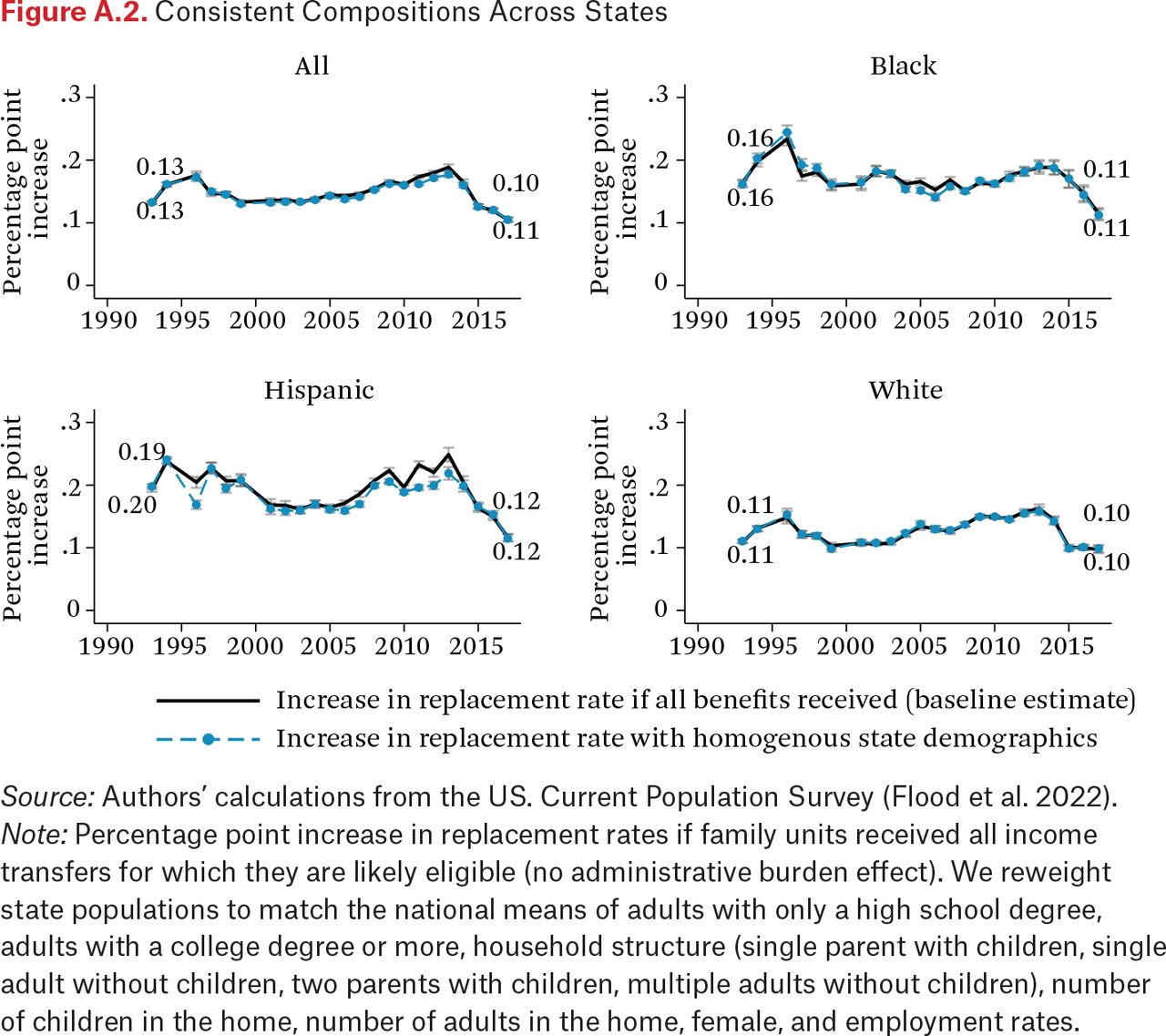
    Figure A.2.

    Consistent Compositions Across States

    Source: Authors’ calculations from the US. Current Population Survey (Flood et al. 2022).

    Note: Percentage point increase in replacement rates if family units received all income transfers for which they are likely eligible (no administrative burden effect). We reweight state populations to match the national means of adults with only a high school degree, adults with a college degree or more, household structure (single parent with children, single adult without children, two parents with children, multiple adults without children), number of children in the home, number of adults in the home, female, and employment rates.

  • Figure A.3.
    • Download figure
    • Open in new tab
    • Download powerpoint
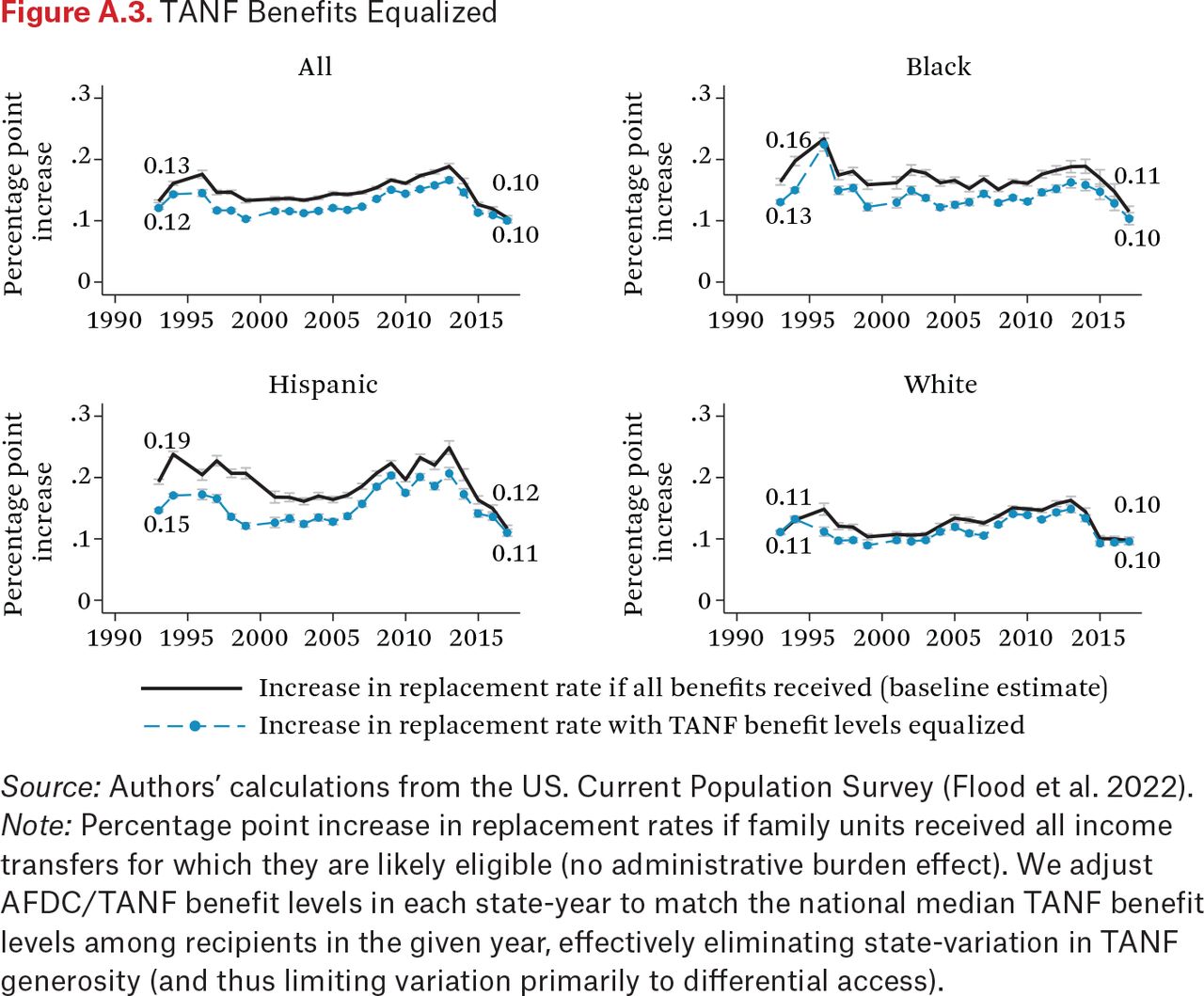
    Figure A.3.

    TANF Benefits Equalized

    Source: Authors’ calculations from the US. Current Population Survey (Flood et al. 2022).

    Note: Percentage point increase in replacement rates if family units received all income transfers for which they are likely eligible (no administrative burden effect). We adjust AFDC/TANF benefit levels in each state-year to match the national median TANF benefit levels among recipients in the given year, effectively eliminating state-variation in TANF generosity (and thus limiting variation primarily to differential access).

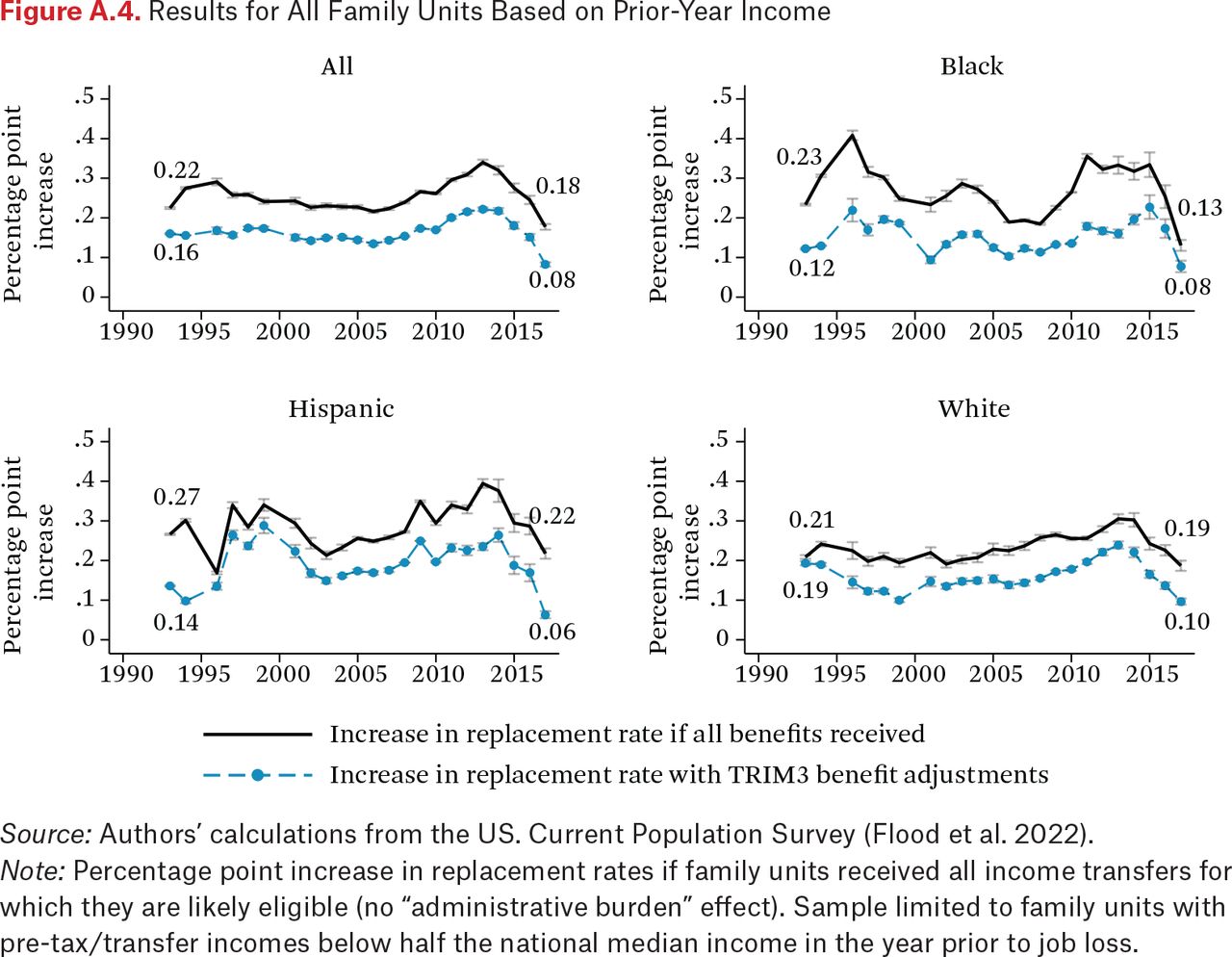
  • Figure A.4.
    • Download figure
    • Open in new tab
    • Download powerpoint
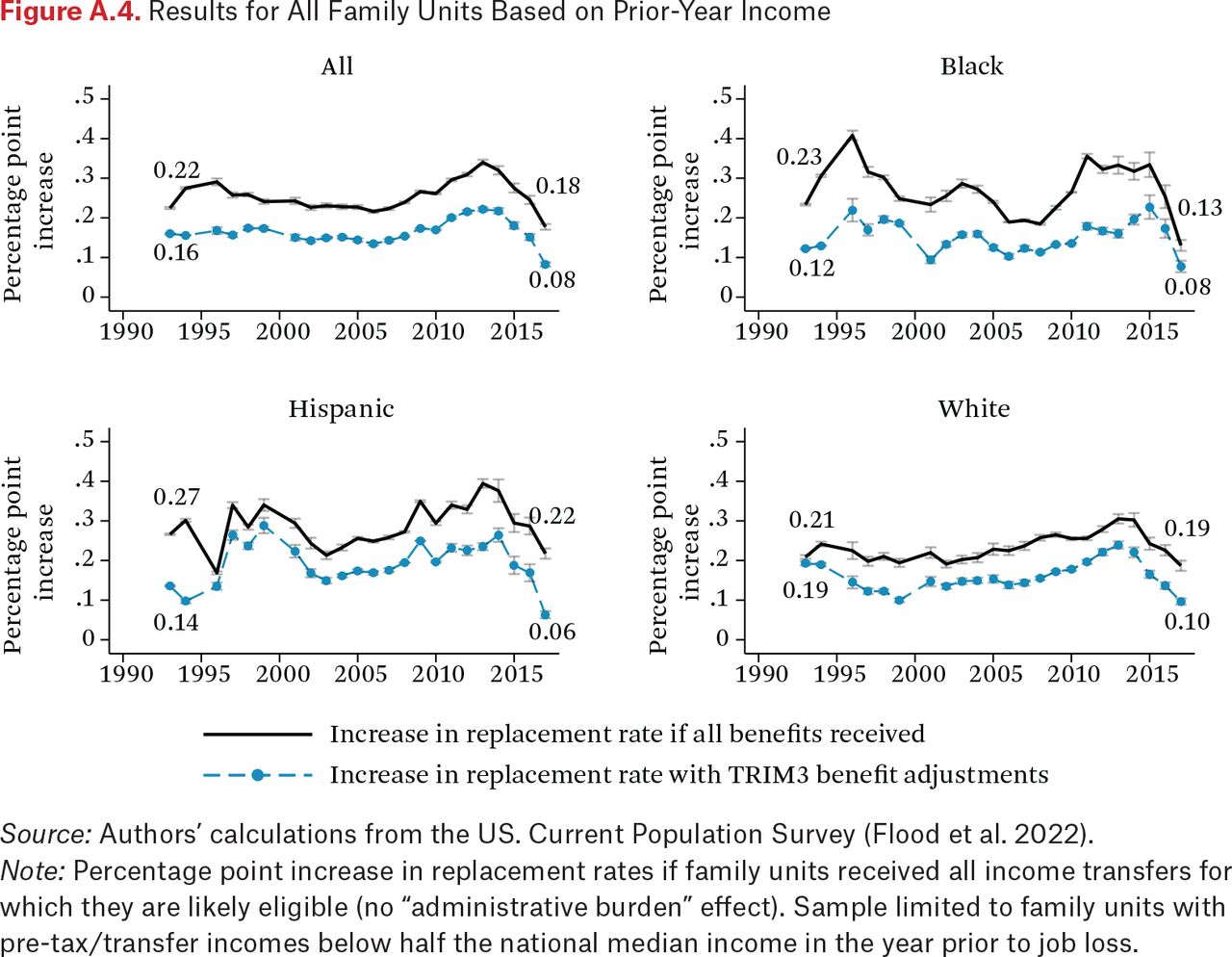
    Figure A.4.

    Results for All Family Units Based on Prior-Year Income

    Source: Authors’ calculations from the US. Current Population Survey (Flood et al. 2022).

    Note: Percentage point increase in replacement rates if family units received all income transfers for which they are likely eligible (no “administrative burden” effect). Sample limited to family units with pre-tax/transfer incomes below half the national median income in the year prior to job loss.

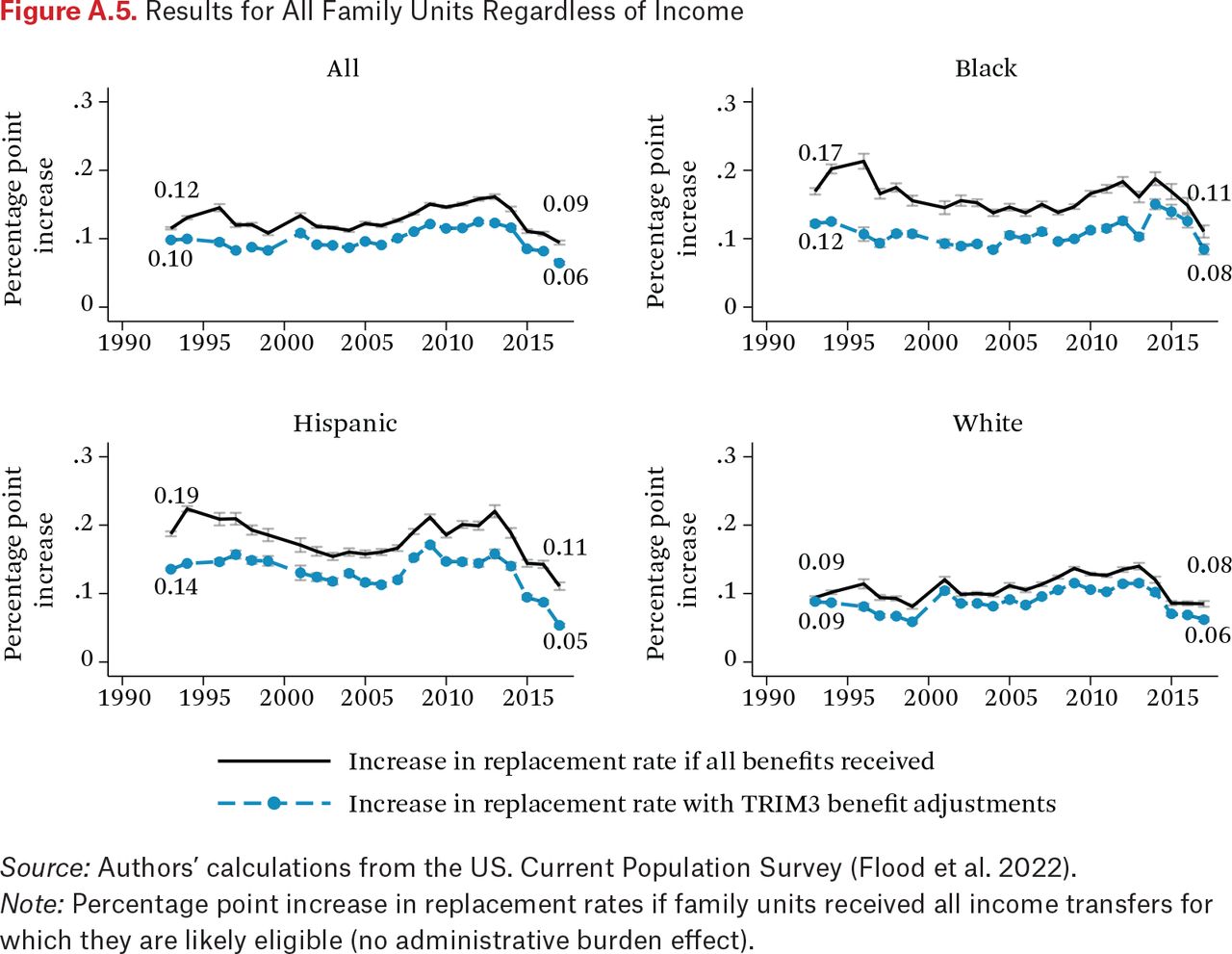
  • Figure A.5.
    • Download figure
    • Open in new tab
    • Download powerpoint
    Figure A.5.

    Results for All Family Units Regardless of Income

    Source: Authors’ calculations from the US. Current Population Survey (Flood et al. 2022).

    Note: Percentage point increase in replacement rates if family units received all income transfers for which they are likely eligible (no administrative burden effect).
PreviousNext
Back to top

In this issue

RSF: The Russell Sage Foundation Journal of the Social Sciences: 9 (5)
RSF: The Russell Sage Foundation Journal of the Social Sciences
Vol. 9, Issue 5
1 Sep 2023
  • Table of Contents
  • Table of Contents (PDF)
  • Cover (PDF)
  • Index by author
  • Front Matter (PDF)
Print
Download PDF
Email Article

Thank you for your interest in spreading the word on RSF: The Russell Sage Foundation Journal of the Social Sciences.

NOTE: We only request your email address so that the person you are recommending the page to knows that you wanted them to see it, and that it is not junk mail. We do not capture any email address.

Enter multiple addresses on separate lines or separate them with commas.
Administrative Burdens and Economic Insecurity Among Black, Latino, and White Families
(Your Name) has sent you a message from RSF: The Russell Sage Foundation Journal of the Social Sciences
(Your Name) thought you would like to see the RSF: The Russell Sage Foundation Journal of the Social Sciences web site.
CAPTCHA
This question is for testing whether or not you are a human visitor and to prevent automated spam submissions.
8 + 2 =
Solve this simple math problem and enter the result. E.g. for 1+3, enter 4.
Citation Tools
Administrative Burdens and Economic Insecurity Among Black, Latino, and White Families
Zachary Parolin, Christina J. Cross, Rourke O’Brien
RSF: The Russell Sage Foundation Journal of the Social Sciences Sep 2023, 9 (5) 56-75; DOI: 10.7758/RSF.2023.9.5.03

Citation Manager Formats

  • BibTeX
  • Bookends
  • EasyBib
  • EndNote (tagged)
  • EndNote 8 (xml)
  • Medlars
  • Mendeley
  • Papers
  • RefWorks Tagged
  • Ref Manager
  • RIS
  • Zotero
Share
Administrative Burdens and Economic Insecurity Among Black, Latino, and White Families
Zachary Parolin, Christina J. Cross, Rourke O’Brien
RSF: The Russell Sage Foundation Journal of the Social Sciences Sep 2023, 9 (5) 56-75; DOI: 10.7758/RSF.2023.9.5.03
del.icio.us logo Twitter logo Facebook logo Mendeley logo
  • Tweet Widget
  • Facebook Like
  • Google Plus One

Jump to section

  • Article
    • Abstract
    • BACKGROUND
    • ADMINISTRATIVE BURDENS IN THE AMERICAN WELFARE STATE
    • WHY FOCUS ON JOB LOSS?
    • DATA AND METHODS
    • FINDINGS
    • ADMINISTRATIVE BURDEN EFFECT
    • CHARACTERISTICS OF STATES WITH LARGE ADMINISTRATIVE BURDEN EFFECTS
    • DISCUSSION AND CONCLUSION
    • Appendices
    • FOOTNOTES
    • REFERENCES
  • Figures & Data
  • Info & Metrics
  • References
  • PDF

Related Articles

  • No related articles found.
  • Google Scholar

Cited By...

  • No citing articles found.
  • Google Scholar

More in this TOC Section

  • The Wait List as Redistributive Policy: Access and Burdens in the Subsidized Childcare System
  • “I Used to Get WIC . . . But Then I Stopped”: How WIC Participants Perceive the Value and Burdens of Maintaining Benefits
Show more IV. Child and Family Supports

Similar Articles

Keywords

  • administrative burdens
  • welfare state
  • inequality
  • poverty

© 2026 RSF: The Russell Sage Foundation Journal of the Social Sciences

Powered by HighWire